In perturbative quantum field theory, Wick's theorem is used to quickly rewrite each time ordered summand in the Dyson series as a sum of normal ordered terms. In the limit of asymptotically free ingoing and outgoing states, these terms correspond to Feynman diagrams.
For two operators and we define their contraction to be
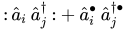
where denotes the normal order of an operator . Alternatively, contractions can be denoted by a line joining and , like .
We shall look in detail at four special cases where and are equal to creation and annihilation operators. For particles we'll denote the creation operators by and the annihilation operators by .
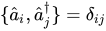
They satisfy the commutation relations for bosonic operators , or the anti-commutation relations for fermionic operators where denotes the Kronecker delta.
We then have
where .
These relationships hold true for bosonic operators or fermionic operators because of the way normal ordering is defined.
We can use contractions and normal ordering to express any product of creation and annihilation operators as a sum of normal ordered terms. This is the basis of Wick's theorem. Before stating the theorem fully we shall look at some examples.
In the last line we have used different numbers of symbols to denote different contractions. By repeatedly applying the commutation relations it takes a lot of work to express in the form of a sum of normally ordered products. It is an even lengthier calculation for more complicated products.
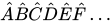
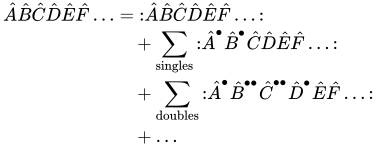
A product of creation and annihilation operators can be expressed as
In other words, a string of creation and annihilation operators can be rewritten as the normal-ordered product of the string, plus the normal-ordered product after all single contractions among operator pairs, plus all double contractions, etc., plus all full contractions.
Applying the theorem to the above examples provides a much quicker method to arrive at the final expressions.
A warning: In terms on the right hand side containing multiple contractions care must be taken when the operators are fermionic. In this case an appropriate minus sign must be introduced according to the following rule: rearrange the operators (introducing minus signs whenever the order of two fermionic operators is swapped) to ensure the contracted terms are adjacent in the string. The contraction can then be applied (See "Rule C" in Wick's paper).
Example:
If we have two fermions () with creation and annihilation operators and () then
Note that the term with contractions of the two creation operators and of the two annihilation operators is not included because their contractions vanish.
We use induction to prove the theorem for bosonic creation and annihilation operators. The base case is trivial, because there is only one possible contraction:
In general, the only non-zero contractions are between an annihilation operator on the left and a creation operator on the right. Suppose that Wick's theorem is true for operators , and consider the effect of adding an Nth operator to the left of to form . By Wick's theorem applied to operators, we have:
is either a creation operator or an annihilation operator. If is a creation operator, all above products, such as , are already normal ordered and require no further manipulation. Because is to the left of all annihilation operators in , any contraction involving it will be zero. Thus, we can add all contractions involving to the sums without changing their value. Therefore, if is a creation operator, Wick's theorem holds for .
Now, suppose that is an annihilation operator. To move from the left-hand side to the right-hand side of all the
products, we repeatedly swap with the operator immediately right of it (call it ), each time applying to account for noncommutativity. Once we do this, all terms will be normal ordered. All terms added to the sums by pushing through the products correspond to additional contractions involving . Therefore, if is an annihilation operator, Wick's theorem holds for .
We have proved the base case and the induction step, so the theorem is true. By introducing the appropriate minus signs, the proof can be extended to fermionic creation and annihilation operators. The theorem applied to fields is proved in essentially the same way.[3]
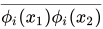
The correlation function that appears in quantum field theory can be expressed by a contraction on the field operators:
where the operator are the amount that do not annihilate the vacuum state . Which means that . This means that is a contraction over . Note that the contraction of a time-ordered string of two field operators is a C-number.
In the end, we arrive at Wick's theorem:
The T-product of a time-ordered free fields string can be expressed in the following manner:
Applying this theorem to S-matrix elements, we discover that normal-ordered terms acting on vacuum state give a null contribution to the sum. We conclude that m is even and only completely contracted terms remain.
where p is the number of interaction fields (or, equivalently, the number of interacting particles) and n is the development order (or the number of vertices of interaction). For example, if
Note that this discussion is in terms of the usual definition of normal ordering which is appropriate for the vacuum expectation values (VEV's) of fields. (Wick's theorem provides as a way of expressing VEV's of n fields in terms of VEV's of two fields.[4]) There are any other possible definitions of normal ordering, and Wick's theorem is valid irrespective. However Wick's theorem only simplifies computations if the definition of normal ordering used is changed to match the type of expectation value wanted. That is we always want the expectation value of the normal ordered product to be zero. For instance in
thermal field theory a different type of expectation value, a thermal trace over the density matrix, requires a different definition of normal ordering.[5]
^Coleman, Sydney (2019). Quantum Field Theory: Lectures of Sidney Coleman. World Scientific Publishing. p. 158.
^See for example also: Mrinal Dasgupta: An introduction to Quantum Field Theory, Lectures presented at the RAL School for High Energy Physics, Somerville College, Oxford, September 2008, section 5.1 Wick's Theorem (downloaded 3 December 2012)









![{\displaystyle [{\hat {a}}_{i},{\hat {a}}_{j}^{\dagger }]=\delta _{ij}}](https://wikimedia.org/api/rest_v1/media/math/render/svg/08ed7ce11ed9cd5d5029697ae2358e9e187254dc)






![{\displaystyle \left[{\hat {a}}_{i}^{\dagger },{\hat {a}}_{j}^{\dagger }\right]=0}](https://wikimedia.org/api/rest_v1/media/math/render/svg/e1fc75e90cf5f42ac82275fe44799338f16010a8)
![{\displaystyle \left[{\hat {a}}_{i},{\hat {a}}_{j}\right]=0}](https://wikimedia.org/api/rest_v1/media/math/render/svg/413c3d406b53f76f4122cd70a421f8f977fdb67c)
![{\displaystyle \left[{\hat {a}}_{i},{\hat {a}}_{j}^{\dagger }\right]=\delta _{ij}}](https://wikimedia.org/api/rest_v1/media/math/render/svg/781ad0826ab6680145c94e8ca49f1683a9ecbbce)
![{\displaystyle \left[{\hat {A}},{\hat {B}}\right]\equiv {\hat {A}}{\hat {B}}-{\hat {B}}{\hat {A}}}](https://wikimedia.org/api/rest_v1/media/math/render/svg/e6fe3a2bc5ffe474018b7ac9b049ce1f87c9bbdf)












![{\displaystyle {\begin{aligned}{\hat {f}}_{1}\,{\hat {f}}_{2}\,{\hat {f}}_{1}^{\dagger }\,{\hat {f}}_{2}^{\dagger }\,={}&\,{\mathopen {:}}{\hat {f}}_{1}\,{\hat {f}}_{2}\,{\hat {f}}_{1}^{\dagger }\,{\hat {f}}_{2}^{\dagger }\,{\mathclose {:}}\\[5pt]&-\,{\hat {f}}_{1}^{\bullet }\,{\hat {f}}_{1}^{\dagger \bullet }\,\,{\mathopen {:}}{\hat {f}}_{2}\,{\hat {f}}_{2}^{\dagger }\,{\mathclose {:}}+\,{\hat {f}}_{1}^{\bullet }\,{\hat {f}}_{2}^{\dagger \bullet }\,\,{\mathopen {:}}{\hat {f}}_{2}\,{\hat {f}}_{1}^{\dagger }\,{\mathclose {:}}+\,{\hat {f}}_{2}^{\bullet }\,{\hat {f}}_{1}^{\dagger \bullet }\,\,{\mathopen {:}}{\hat {f}}_{1}\,{\hat {f}}_{2}^{\dagger }\,{\mathclose {:}}-{\hat {f}}_{2}^{\bullet }\,{\hat {f}}_{2}^{\dagger \bullet }\,\,{\mathopen {:}}{\hat {f}}_{1}\,{\hat {f}}_{1}^{\dagger }\,{\mathclose {:}}\\[5pt]&-{\hat {f}}_{1}^{\bullet \bullet }\,{\hat {f}}_{1}^{\dagger \bullet \bullet }\,{\hat {f}}_{2}^{\bullet }\,{\hat {f}}_{2}^{\dagger \bullet }\,+{\hat {f}}_{1}^{\bullet \bullet }\,{\hat {f}}_{2}^{\dagger \bullet \bullet }\,{\hat {f}}_{2}^{\bullet }\,{\hat {f}}_{1}^{\dagger \bullet }\,\end{aligned}}}](https://wikimedia.org/api/rest_v1/media/math/render/svg/86de3afbbb2eee81acf29190448febd7e4946a00)