


John McCain


John McCain | |||||||||||||||||||||||||||||||||||||||||||||||
|---|---|---|---|---|---|---|---|---|---|---|---|---|---|---|---|---|---|---|---|---|---|---|---|---|---|---|---|---|---|---|---|---|---|---|---|---|---|---|---|---|---|---|---|---|---|---|---|
 Official portrait, 2009 | |||||||||||||||||||||||||||||||||||||||||||||||
| United States Senator from Arizona | |||||||||||||||||||||||||||||||||||||||||||||||
| In office January 3, 1987 – August 25, 2018 | |||||||||||||||||||||||||||||||||||||||||||||||
| Preceded by | Barry Goldwater | ||||||||||||||||||||||||||||||||||||||||||||||
| Succeeded by | Jon Kyl | ||||||||||||||||||||||||||||||||||||||||||||||
| Member of the U.S. House of Representatives from Arizona's 1st district | |||||||||||||||||||||||||||||||||||||||||||||||
| In office January 3, 1983 – January 3, 1987 | |||||||||||||||||||||||||||||||||||||||||||||||
| Preceded by | John Jacob Rhodes | ||||||||||||||||||||||||||||||||||||||||||||||
| Succeeded by | John Jacob Rhodes III | ||||||||||||||||||||||||||||||||||||||||||||||
| |||||||||||||||||||||||||||||||||||||||||||||||
| Personal details | |||||||||||||||||||||||||||||||||||||||||||||||
| Born | John Sidney McCain III August 29, 1936 Coco Solo, Panama Canal Zone | ||||||||||||||||||||||||||||||||||||||||||||||
| Died | August 25, 2018 (aged 81) Cornville, Arizona, U.S. | ||||||||||||||||||||||||||||||||||||||||||||||
| Resting place | United States Naval Academy Cemetery | ||||||||||||||||||||||||||||||||||||||||||||||
| Political party | Republican | ||||||||||||||||||||||||||||||||||||||||||||||
| Spouses | |||||||||||||||||||||||||||||||||||||||||||||||
| Children | 7, including Meghan | ||||||||||||||||||||||||||||||||||||||||||||||
| Parents | |||||||||||||||||||||||||||||||||||||||||||||||
| Relatives | Joe McCain (brother) | ||||||||||||||||||||||||||||||||||||||||||||||
| Education | United States Naval Academy (BS) | ||||||||||||||||||||||||||||||||||||||||||||||
| Civilian awards | Presidential Medal of Freedom (posthumous, 2022) | ||||||||||||||||||||||||||||||||||||||||||||||
| Signature |  | ||||||||||||||||||||||||||||||||||||||||||||||
| Website | Senate website | ||||||||||||||||||||||||||||||||||||||||||||||
| Nickname | John Wayne | ||||||||||||||||||||||||||||||||||||||||||||||
| Military service | |||||||||||||||||||||||||||||||||||||||||||||||
| Branch/service | United States Navy | ||||||||||||||||||||||||||||||||||||||||||||||
| Years of service | 1958–1981 | ||||||||||||||||||||||||||||||||||||||||||||||
| Rank | Captain | ||||||||||||||||||||||||||||||||||||||||||||||
| Battles/wars | |||||||||||||||||||||||||||||||||||||||||||||||
| Military awards |
| ||||||||||||||||||||||||||||||||||||||||||||||
John Sidney McCain III (August 29, 1936 – August 25, 2018) was an American politician and United States Navy officer who served as a United States senator from Arizona from 1987 until his death in 2018. He previously served two terms in the United States House of Representatives and was the Republican nominee for president of the United States in the 2008 election, which he lost to Barack Obama.
McCain was a son of Admiral John S. McCain Jr. and grandson of Admiral John S. McCain Sr. He graduated from the United States Naval Academy in 1958 and received a commission in the United States Navy. McCain became a naval aviator and flew ground-attack aircraft from aircraft carriers. During the Vietnam War, he almost died in the 1967 USS Forrestal fire. While on a bombing mission during Operation Rolling Thunder over Hanoi in October 1967, McCain was shot down, seriously injured, and captured by the North Vietnamese. He was a prisoner of war until 1973. McCain experienced episodes of torture and refused an out-of-sequence early release. During the war, he sustained wounds that left him with lifelong physical disabilities. McCain retired from the Navy as a captain in 1981 and moved to Arizona.
In 1982, McCain was elected to the United States House of Representatives, where he served two terms. Four years later, he was elected to the United States Senate, where he served six terms. While generally adhering to conservative principles, McCain also gained a reputation as a "maverick" for his willingness to break from his party on certain issues, including LGBT rights, gun regulations, and campaign finance reform where his stances were more moderate than those of the party's base. McCain was investigated and largely exonerated in a political influence scandal of the 1980s as one of the Keating Five; he then made regulating the financing of political campaigns one of his signature concerns, which eventually resulted in passage of the McCain–Feingold Act in 2002. He was also known for his work in the 1990s to restore diplomatic relations with Vietnam. McCain chaired the Senate Commerce Committee from 1997 to 2001 and 2003 to 2005, where he opposed pork barrel spending and earmarks. He belonged to the bipartisan "Gang of 14", which played a key role in alleviating a crisis over judicial nominations.
McCain entered the race for the Republican presidential nomination in 2000 but lost a heated primary season contest to George W. Bush. He secured the Republican presidential nomination in 2008, beating fellow candidates Mitt Romney and Mike Huckabee, though he lost the general election to Barack Obama. McCain subsequently adopted more orthodox conservative stances and attitudes and largely opposed actions of the Obama administration, especially with regard to foreign policy matters. In 2015, he became Chairman of the Senate Armed Services Committee. He refused to support then-Republican presidential nominee Donald Trump in the 2016 election and later became a vocal critic of the Trump administration. While McCain opposed the Obama-era Affordable Care Act (ACA), he cast the deciding vote against the ACA-repealing American Health Care Act of 2017. After being diagnosed with glioblastoma in 2017, he reduced his role in the Senate to focus on treatment; he died from the disease in 2018.
Early life and military career (1936–1981)
Early life and education
John Sidney McCain III was born on August 29, 1936, at Coco Solo Naval Air Station in the Panama Canal Zone, to naval officer John S. McCain Jr. and Roberta (Wright) McCain. He had an older sister, Sandy, and a younger brother, Joe.[2] At that time, the Panama Canal was under U.S. control,[3] and he was granted U.S. citizenship at the age of eleven months.[4]
McCain's family tree includes Scots-Irish and English ancestors.[5] His great-great-great-grandparents owned High Rock Farm, a plantation in Rockingham County, North Carolina.[6] His father and his paternal grandfather, John S. McCain Sr., were also Naval Academy graduates and both became four-star admirals in the United States Navy.[7] The McCain family moved with their father as he took various naval postings in the United States and in the Pacific.[2][8]
As a result, the younger McCain attended a total of about 20 schools.[9] In 1951, the family settled in Northern Virginia, and McCain attended Episcopal High School, a private preparatory boarding school in Alexandria.[10][11] He excelled at wrestling and graduated in 1954.[12][13] He referred to himself as an Episcopalian as recently as June 2007, after which date he said he came to identify as a Baptist.[14]

Following in the footsteps of his father and grandfather, McCain entered the United States Naval Academy, where he was a friend and informal leader for many of his classmates[15] and sometimes stood up for targets of bullying.[7] He also fought as a lightweight boxer.[16] He earned the nickname "John Wayne" "for his attitude and popularity with the opposite sex."[17] McCain did well in academic subjects that interested him, such as literature and history, but studied only enough to pass subjects that gave him difficulty, such as mathematics.[7][18] He came into conflict with higher-ranking personnel and did not always obey the rules. "He collected demerits the way some people collect stamps."[17] His class rank (894 of 899) was not indicative of his intelligence nor his IQ, which had been tested to be 128 and 133.[15][19] McCain graduated in 1958.[15]
McCain began his early military career when he was commissioned as an ensign, and started two and a half years of training at Pensacola to become a naval aviator.[20] While there, he earned a reputation as a man who partied.[9] He completed flight school in 1960, and became a naval pilot of ground-attack aircraft; he was assigned to A-1 Skyraider squadrons[21] aboard the aircraft carriers USS Intrepid and USS Enterprise[22] in the Caribbean and Mediterranean Seas.[23] McCain began as a sub-par flier[23] who was at times careless and reckless;[24] during the early to mid-1960s, two of his flight missions crashed, and a third mission collided with power lines, but he received no major injuries.[24] His aviation skills improved over time,[23] and he was seen as a good pilot, albeit one who tended to "push the envelope" in his flying.[24]

On July 3, 1965, McCain was 28 when he married Carol Shepp, who had worked as a runway model and secretary.[25] McCain adopted her two young children, Douglas and Andrew.[22][26] He and Carol then had a daughter whom they named Sidney.[27][28] The same year, he was a one-day champion on the game show Jeopardy![29]
McCain requested a combat assignment,[30] and was assigned to the aircraft carrier USS Forrestal flying A-4 Skyhawks.[31] His combat duty began when he was 30 years old in mid-1967, when Forrestal was assigned to a bombing campaign, Operation Rolling Thunder, during the Vietnam War.[25][32] Stationed in the Gulf of Tonkin, McCain and his fellow pilots became frustrated by micromanagement from Washington, and he later wrote, "In all candor, we thought our civilian commanders were complete idiots who didn't have the least notion of what it took to win the war."[32][33]
On July 29, 1967, McCain was a lieutenant commander when he was near the center of the USS Forrestal fire. He escaped from his burning jet and was trying to help another pilot escape when a bomb exploded;[34] McCain was struck in the legs and chest by fragments.[35] The ensuing fire killed 134 sailors and took 24 hours to control.[36][37] With the Forrestal out of commission, McCain volunteered for assignment with the USS Oriskany, another aircraft carrier employed in Operation Rolling Thunder.[38] There, he was awarded the Navy Commendation Medal and the Bronze Star Medal for missions flown over North Vietnam.[39]
Prisoner of war
McCain was taken prisoner of war on October 26, 1967. He was flying his 23rd bombing mission over North Vietnam when his A-4E Skyhawk was shot down by a missile over Hanoi.[40][41] McCain fractured both arms and a leg when he ejected from the aircraft,[42] and nearly drowned after he parachuted into Trúc Bạch Lake. Some North Vietnamese pulled him ashore, then others crushed his shoulder with a rifle butt and bayoneted him.[40] McCain was then transported to Hanoi's main Hỏa Lò Prison, nicknamed the "Hanoi Hilton".[41]
Although McCain was seriously wounded and injured, his captors refused to treat him. They beat and interrogated him to get information, and he was given medical care only when the North Vietnamese discovered that his father was an admiral.[43] His status as a prisoner of war (POW) made the front pages of major American newspapers.[44][45]
McCain spent six weeks in the hospital, where he received marginal care. He had lost 50 pounds (23 kg), he was in a chest cast, and his gray hair had turned white.[40] McCain was sent to a different camp on the outskirts of Hanoi.[46] In December 1967, McCain was placed in a cell with two other Americans, who did not expect him to live more than a week.[47] In March 1968, McCain was placed into solitary confinement, where he remained for two years.[48]
In mid-1968, his father John S. McCain Jr. was named commander of all U.S. forces in the Vietnam theater, and the North Vietnamese offered McCain early release[49] because they wanted to appear merciful for propaganda purposes,[50] and also to show other POWs that elite prisoners were willing to be treated preferentially.[49] McCain refused repatriation unless every man taken in before him was also released. Such early release was prohibited by the POWs' interpretation of the military Code of Conduct, which states in Article III: "I will accept neither parole nor special favors from the enemy."[51] To prevent the enemy from using prisoners for propaganda, officers were to agree to be released in the order in which they were captured.[40]
Beginning in August 1968, McCain was subjected to a program of severe torture.[52] He was bound and beaten every two hours; this punishment occurred at the same time that he was suffering from heat exhaustion and dysentery.[40][52] Further injuries brought McCain to "the point of suicide," but his preparations were interrupted by guards. Eventually, McCain made an anti-U.S. propaganda "confession."[40] He had always felt that his statement was dishonorable, but as he later wrote, "I had learned what we all learned over there: every man has his breaking point. I had reached mine."[53][54] Many U.S. POWs were tortured and maltreated to extract "confessions" and propaganda statements;[55] virtually all of them eventually yielded something to their captors.[56] McCain received two to three beatings weekly because of his continued refusal to sign additional statements.[57]
McCain refused to meet various anti-war groups seeking peace in Hanoi, wanting to give neither them nor the North Vietnamese a propaganda victory.[58] From late 1969, treatment of McCain and many of the other POWs became more tolerable,[59] while McCain continued to resist the camp authorities.[60] McCain and other prisoners cheered the U.S. "Christmas Bombing" campaign of December 1972, viewing it as a forceful measure to push North Vietnam to terms.[54][61]
McCain was a prisoner of war in North Vietnam for five and a half years, until his release on March 14, 1973, along with 108 other prisoners of war.[62] His wartime injuries left him permanently incapable of raising his arms above his head.[63] After the war, McCain, accompanied by his family and his second wife Cindy, returned to the site on a few occasions in efforts of trying to come to terms with what had happened to him there during his capture.[64]
Commanding officer, liaison to Senate, and second marriage
McCain was reunited with his family when he returned to the United States. His wife Carol had been severely injured by an automobile accident in December 1969. She was then four inches shorter, in a wheelchair or on crutches, and substantially heavier than when he had last seen her. As a returned POW, he became a celebrity of sorts.[65]


McCain underwent treatment for his injuries that included months of physical therapy.[66] He attended the National War College at Fort McNair in Washington, D.C., during 1973–1974.[67] He was rehabilitated by late 1974, and his flight status was reinstated. In 1976, he became Commanding Officer of a training squadron that was stationed in Florida.[65][68] He improved the unit's flight readiness and safety records,[69] and won the squadron its first-ever Meritorious Unit Commendation.[68] During this period in Florida, he had extramarital affairs, and his marriage began to falter, about which he later stated: "The blame was entirely mine".[70][71]
McCain served as the Navy's liaison to the U.S. Senate beginning in 1977.[72] In retrospect, he said that this represented his "real entry into the world of politics, and the beginning of my second career as a public servant."[65] His key behind-the-scenes role gained congressional financing for a new supercarrier against the wishes of the Carter administration.[66][73]
In April 1979,[66] McCain met Cindy Lou Hensley, a teacher from Phoenix, Arizona, whose father had founded a large beer distributorship.[71] They began dating, and he urged his wife, Carol, to grant him a divorce, which she did in February 1980; the uncontested divorce took effect in April 1980.[26][66] The settlement included two houses, and financial support for her ongoing medical treatments due to her 1969 car accident; they remained on good terms.[71] McCain and Hensley were married on May 17, 1980, with Senators William Cohen and Gary Hart attending as groomsmen.[25][71] McCain's children did not attend, and several years passed before they reconciled.[28][66] John and Cindy McCain entered into a prenuptial agreement that kept most of her family's assets under her name; they kept their finances apart, and filed separate income tax returns.[74]

McCain decided to leave the Navy. It was doubtful whether he would ever be promoted to the rank of full admiral, as he had poor annual physicals and had not been given a major sea command.[75] His chances of being promoted to rear admiral were better, but he declined that prospect, as he had already made plans to run for Congress and said he could "do more good there."[76][77]
McCain retired from the Navy as a captain on April 1, 1981.[39][78] He was designated as disabled and awarded a disability pension.[79] Upon leaving the military, he moved to Arizona. His numerous military decorations and awards include: the Silver Star, two Legion of Merits, Distinguished Flying Cross, three Bronze Star Medals, two Purple Hearts, two Navy and Marine Corps Commendation Medals, and the Prisoner of War Medal.[39]
House and Senate elections and career (1982–2000)
U.S. Representative
McCain set his sights on becoming a representative because he was interested in current events, was ready for a new challenge, and had developed political ambitions during his time as Senate liaison.[71][80][81] Living in Phoenix, he went to work for Hensley & Co., his new father-in-law Jim Hensley's large Anheuser-Busch beer distributorship.[71] As vice president of public relations at the distributorship, he gained political support among the local business community, meeting powerful figures such as banker Charles Keating Jr., real estate developer Fife Symington III (later Governor of Arizona) and newspaper publisher Darrow "Duke" Tully.[72] In 1982, McCain ran as a Republican for an open seat in Arizona's 1st congressional district, which was being vacated by 30-year incumbent Republican John Jacob Rhodes.[82] A newcomer to the state, McCain was hit with charges of being a carpetbagger.[71] McCain responded to a voter making that charge with what a Phoenix Gazette columnist later described as "the most devastating response to a potentially troublesome political issue I've ever heard":[71]
Listen, pal. I spent 22 years in the Navy. My father was in the Navy. My grandfather was in the Navy. We in the military service tend to move a lot. We have to live in all parts of the country, all parts of the world. I wish I could have had the luxury, like you, of growing up and living and spending my entire life in a nice place like the First District of Arizona, but I was doing other things. As a matter of fact, when I think about it now, the place I lived longest in my life was Hanoi.[71][83]
McCain won a highly contested primary election with the assistance of local political endorsements, his Washington connections, and money that his wife lent to his campaign.[71][72] He then easily won the general election in the heavily Republican district.[71]

In 1983, McCain was elected to lead the incoming group of Republican representatives,[71] and was assigned to the House Committee on Interior Affairs. Also that year, he opposed creation of a federal Martin Luther King Jr. Day, but admitted in 2008: "I was wrong and eventually realized that, in time to give full support [in 1990] for a state holiday in Arizona."[84][85]
At this point, McCain's politics were mainly in line with those of President Ronald Reagan; this included support for Reaganomics, and he was active on Indian Affairs bills.[86] He supported most aspects of the foreign policy of the Reagan administration, including its hardline stance against the Soviet Union and policy towards Central American conflicts, such as backing the Contras in Nicaragua.[86] McCain opposed keeping U.S. Marines deployed in Lebanon, citing unattainable objectives, and subsequently criticized President Reagan for pulling out the troops too late; in the interim, the 1983 Beirut barracks bombing killed hundreds.[71][87] McCain won re-election to the House easily in 1984,[71] and gained a spot on the House Foreign Affairs Committee.[88] In 1985, he made his first return trip to Vietnam,[89] and also traveled to Chile where he met with its military junta ruler, General Augusto Pinochet.[90][91][92]
Growing family
In 1984, McCain and Cindy had their first child, daughter Meghan, followed two years later by son John IV and in 1988 by son James.[93] In 1991, Cindy brought an abandoned three-month-old girl needing medical treatment to the U.S. from a Bangladeshi orphanage run by Mother Teresa.[94] The McCains decided to adopt her and named her Bridget.[95]
First two terms in the U.S. Senate
McCain's Senate career began in January 1987, after he defeated his Democratic opponent, former state legislator Richard Kimball, by 20 percentage points in the 1986 election.[72][96] McCain succeeded Arizona native, conservative icon, and the 1964 Republican presidential nominee Barry Goldwater upon Goldwater's retirement as U.S. senator from Arizona for 30 years.[96] In January 1988, McCain voted in favor of the Civil Rights Restoration Act of 1987,[97] and voted to override President Reagan's veto of that legislation the following March.[98]

Senator McCain became a member of the Armed Services Committee, with which he had formerly done his Navy liaison work; he also joined the Commerce Committee and the Indian Affairs Committee.[96] He continued to support the Native American agenda.[99] As first a House member and then a senator—and as a lifelong gambler with close ties to the gambling industry[100]—McCain was one of the main authors of the 1988 Indian Gaming Regulatory Act,[101][102] which codified rules regarding Native American gambling enterprises.[103] McCain was also a strong supporter of the Gramm–Rudman legislation that enforced automatic spending cuts in the case of budget deficits.[104]
McCain soon gained national visibility. He delivered a well-received speech at the 1988 Republican National Convention, was mentioned by the press as a short list vice-presidential running mate for Republican nominee George H. W. Bush, and was named chairman of Veterans for Bush.[96][105]
Keating Five
McCain became embroiled in a scandal during the 1980s, as one of five United States senators comprising the so-called Keating Five.[106] Between 1982 and 1987, McCain had received $112,000 in lawful[107] political contributions from Charles Keating Jr. and his associates at Lincoln Savings and Loan Association, along with trips on Keating's jets[106] that McCain belatedly repaid, in 1989.[108] In 1987, McCain was one of the five senators whom Keating contacted to prevent the government's seizure of Lincoln, and McCain met twice with federal regulators to discuss the government's investigation of Lincoln.[106] In 1999, McCain said: "The appearance of it was wrong. It's a wrong appearance when a group of senators appear in a meeting with a group of regulators, because it conveys the impression of undue and improper influence. And it was the wrong thing to do."[109] In the end, McCain was cleared by the Senate Ethics Committee of acting improperly or violating any law or Senate rule, but was mildly rebuked for exercising "poor judgment".[107][109][110]
In his 1992 re-election bid, the Keating Five affair was not a major issue,[111] and he won handily, gaining 56 percent of the vote to defeat Democratic community and civil rights activist Claire Sargent and independent former governor, Evan Mecham.[112]
.jpg)
Political independence
McCain developed a reputation for independence during the 1990s.[113] He took pride in challenging party leadership and establishment forces, becoming difficult to categorize politically.[113]
.jpg)
As a member of the 1991–1993 Senate Select Committee on POW/MIA Affairs, chaired by fellow Vietnam War veteran and Democrat, John Kerry, McCain investigated the Vietnam War POW/MIA issue, to determine the fate of U.S. service personnel listed as missing in action during the Vietnam War.[114] The committee's unanimous report stated there was "no compelling evidence that proves that any American remains alive in captivity in Southeast Asia."[115] Helped by McCain's efforts, in 1995 the U.S. normalized diplomatic relations with Vietnam.[116] McCain was vilified by some POW/MIA activists who, despite the committee's unanimous report, believed large numbers of Americans were still held against their will in Southeast Asia.[116][117][118] From January 1993 until his death, McCain was Chairman of the International Republican Institute, an organization partly funded by the U.S. government that supports the emergence of political democracy worldwide.[119]
In 1993 and 1994, McCain voted to confirm President Clinton's nominees the to U.S. Supreme Court, Ruth Bader Ginsburg and Stephen Breyer, whom he considered qualified. He later explained that "under our Constitution, it is the president's call to make."[120] McCain had also voted to confirm nominees of presidents Ronald Reagan and George H. W. Bush, including Robert Bork and Clarence Thomas.[121]
Campaign finance reform
McCain attacked what he saw as the corrupting influence of large political contributions—from corporations, labor unions, other organizations, and wealthy individuals—and he made this his signature issue.[122] Starting in 1994, he worked with Democratic Wisconsin Senator Russ Feingold on campaign finance reform; their McCain–Feingold bill attempted to put limits on "soft money".[122] The efforts of McCain and Feingold were opposed by some of the moneyed interests targeted, by incumbents in both parties, by those who felt spending limits impinged on free political speech and might be unconstitutional as well, and by those who wanted to counterbalance the power of what they saw as media bias.[122][123] Despite sympathetic coverage in the media, initial versions of the McCain–Feingold Act were filibustered and never came to a vote.[124]
The term "maverick Republican" became a label frequently applied to McCain, and he also used it himself.[122][125][126] In 1993, McCain opposed military operations in Somalia.[127] Another target of his was pork barrel spending by Congress, and he actively supported the Line Item Veto Act of 1996, which gave the president power to veto individual spending items[122] but was ruled unconstitutional by the Supreme Court in 1998.[128]
In the 1996 presidential election, McCain was again on the short list of possible vice-presidential picks, this time for Republican nominee Bob Dole.[111][129] While Dole instead selected Jack Kemp, he chose McCain to deliver the nominating speech for him in the presidential roll call vote at the 1996 Republican National Convention.[130] The following year, Time magazine named McCain as one of the "25 Most Influential People in America".[131]
In 1997, McCain became chairman of the powerful Senate Commerce Committee; he was criticized for accepting funds from corporations and businesses under the committee's purview, but in response said the small contributions he received were not part of the big-money nature of the campaign finance problem.[122] McCain took on the tobacco industry in 1998, proposing legislation that would increase cigarette taxes to fund anti-smoking campaigns, discourage teenage smokers, increase money for health research studies, and help states pay for smoking-related health care costs.[122][132] Supported by the Clinton administration but opposed by the industry and most Republicans, the bill failed to gain cloture.[132]
Start of third term in the U.S. Senate
In November 1998, McCain won re-election to a third Senate term; he prevailed in a landslide over his Democratic opponent, environmental lawyer Ed Ranger.[122] In the February 1999 Senate trial following the impeachment of Bill Clinton, McCain voted to convict the president on both the perjury and obstruction of justice counts, saying Clinton had violated his sworn oath of office.[133] In March 1999, McCain voted to approve the NATO bombing campaign against the Federal Republic of Yugoslavia, saying that the ongoing genocide of the Kosovo War must be stopped and criticizing past Clinton administration inaction.[134] Later in 1999, McCain shared the Profile in Courage Award with Feingold for their work in trying to enact their campaign finance reform,[135] although the bill was still failing repeated attempts to gain cloture.[124]

In August 1999, McCain's memoir Faith of My Fathers, co-authored with Mark Salter, was published;[136] a reviewer observed that its appearance "seems to have been timed to the unfolding Presidential campaign."[137] The most successful of his writings, it received positive reviews,[138] became a bestseller,[139] and was later made into a TV film.[140] The book traces McCain's family background and childhood, covers his time at Annapolis and his service before and during the Vietnam War, concluding with his release from captivity in 1973. According to one reviewer, it describes "the kind of challenges that most of us can barely imagine. It's a fascinating history of a remarkable military family."[141]
2000 presidential campaign
McCain announced his candidacy for president on September 27, 1999, in Nashua, New Hampshire, saying he was staging "a fight to take our government back from the power brokers and special interests, and return it to the people and the noble cause of freedom it was created to serve".[136][142] The frontrunner for the Republican nomination was Texas Governor George W. Bush, who had the political and financial support of most of the party establishment, whereas McCain was supported by many moderate Republicans and some conservative Republicans.[143]
McCain focused on the New Hampshire primary, where his message appealed to independents.[144] He traveled on a campaign bus called the Straight Talk Express.[136] He held many town hall meetings, answering every question voters asked, in a successful example of "retail politics", and he used free media to compensate for his lack of funds.[136] One reporter later recounted that, "McCain talked all day long with reporters on his Straight Talk Express bus; he talked so much that sometimes he said things that he shouldn't have, and that's why the media loved him."[145] On February 1, 2000, he won New Hampshire's primary with 49 percent of the vote to Bush's 30 percent. The Bush campaign and the Republican establishment feared that a McCain victory in the crucial South Carolina primary might give his campaign unstoppable momentum.[136][146]

The Arizona Republic wrote that the McCain–Bush primary contest in South Carolina "has entered national political lore as a low-water mark in presidential campaigns", while The New York Times called it "a painful symbol of the brutality of American politics".[136][148][149] A variety of interest groups, which McCain had challenged in the past, ran negative ads.[136][150] Bush borrowed McCain's earlier language of reform,[151] and declined to dissociate himself from a veterans activist who accused McCain (in Bush's presence) of having "abandoned the veterans" on POW/MIA and Agent Orange issues.[136][152]
Incensed,[152] McCain ran ads accusing Bush of lying and comparing the governor to Bill Clinton, which Bush said was "about as low a blow as you can give in a Republican primary".[136] An anonymous smear campaign began against McCain, delivered by push polls, faxes, e-mails, flyers, and audience plants.[136][153] The smears claimed that McCain had fathered a black child out of wedlock (the McCains' dark-skinned daughter was adopted from Bangladesh), that his wife Cindy was a drug addict, that he was a homosexual, and that he was a "Manchurian Candidate" who was either a traitor or mentally unstable from his North Vietnam POW days.[136][148] The Bush campaign strongly denied any involvement with the attacks.[148][154]
McCain lost South Carolina on February 19, with 42 percent of the vote to Bush's 53 percent,[155] in part because Bush mobilized the state's evangelical voters[136][156] and outspent McCain.[157] The win allowed Bush to regain lost momentum.[155] McCain said of the rumor spreaders, "I believe that there is a special place in hell for people like those."[95] According to one acquaintance, the South Carolina experience left him in a "very dark place".[148]
McCain's campaign never completely recovered from his South Carolina defeat, although he did rebound partially by winning in Arizona and Michigan a few days later.[158] He made a speech in Virginia Beach that criticized Christian leaders, including Pat Robertson and Jerry Falwell, as divisive conservatives,[148] declaring "... we embrace the fine members of the religious conservative community. But that does not mean that we will pander to their self-appointed leaders."[159] McCain lost the Virginia primary on February 29,[160] and on March 7 lost nine of the thirteen primaries on Super Tuesday to Bush.[161] With little hope of overcoming Bush's delegate lead, McCain withdrew from the race on March 9, 2000.[162] He endorsed Bush two months later,[163] and made occasional appearances with the Texas governor during the general election campaign.[136]
Senate career (2000–2008)
Remainder of third Senate term
McCain began 2001 by breaking with the new George W. Bush administration on a number of matters, including HMO reform, climate change, and gun control legislation; McCain–Feingold was opposed by Bush as well.[124][164] In May 2001, McCain was one of only two Senate Republicans to vote against the Bush tax cuts.[164][165] Besides the differences with Bush on ideological grounds, there was considerable antagonism between the two remaining from the previous year's campaign.[166][167] Later, when a Republican senator, Jim Jeffords, became an Independent, thereby throwing control of the Senate to the Democrats, McCain defended Jeffords against "self-appointed enforcers of party loyalty".[164] Indeed, there was speculation at the time, and in years since, about McCain himself leaving the Republican Party, but McCain had always adamantly denied that he ever considered doing so.[164][168][169] Beginning in 2001, McCain used political capital gained from his presidential run, as well as improved legislative skills and relationships with other members, to become one of the Senate's most influential members.[170]
After the September 11, 2001, attacks, McCain supported Bush and the U.S.-led war in Afghanistan.[164][171] He and Democratic senator Joe Lieberman wrote the legislation that created the 9/11 Commission,[172] while he and Democratic senator Fritz Hollings co-sponsored the Aviation and Transportation Security Act that federalized airport security.[173]
In March 2002, McCain–Feingold, officially known as the Bipartisan Campaign Reform Act of 2002, passed in both Houses of Congress and was signed into law by President Bush.[124][164] Seven years in the making, it was McCain's greatest legislative achievement.[164][174]

Meanwhile, in discussions over proposed U.S. action against Iraq, McCain was a strong supporter of the Bush administration's position.[164] He stated that Iraq was "a clear and present danger to the United States of America", and voted accordingly for the Iraq War Resolution in October 2002.[164] He predicted that U.S. forces would be treated as liberators by a large number of the Iraqi people.[175] In May 2003, McCain voted against the second round of Bush tax cuts, saying it was unwise at a time of war.[165] By November 2003, after a trip to Iraq, he was publicly questioning Secretary of Defense Donald Rumsfeld, saying that more U.S. troops were needed; the following year, McCain announced that he had lost confidence in Rumsfeld.[176][177]
In October 2003, McCain and Lieberman co-sponsored the Climate Stewardship Act that would have introduced a cap and trade system aimed at returning greenhouse gas emissions to 2000 levels; the bill was defeated with 55 votes to 43 in the Senate.[178] They reintroduced modified versions of the Act two additional times, for the final time in January 2007 with the co-sponsorship of Barack Obama, among others.[179]

In the 2004 U.S. presidential election campaign, McCain was once again frequently mentioned for the vice-presidential slot, only this time as part of the Democratic ticket under nominee John Kerry.[180][181][182] McCain said that Kerry had never formally offered him the position and that he would not have accepted it if he had.[181][182][183] At the 2004 Republican National Convention, McCain supported Bush for re-election, praising Bush's management of the War on Terror since the September 11 attacks.[184] At the same time, he defended Kerry's Vietnam War record.[185] By August 2004, McCain had the best favorable-to-unfavorable rating (55 percent to 19 percent) of any national politician;[184] he campaigned for Bush much more than he had four years previously, though the two remained situational allies rather than friends.[166]
McCain was also up for re-election as senator, in 2004. He defeated little-known Democratic schoolteacher Stuart Starky with his biggest margin of victory, garnering 77 percent of the vote.[186]
Start of fourth Senate term
In May 2005, McCain led the so-called Gang of 14 in the Senate, which established a compromise that preserved the ability of senators to filibuster judicial nominees, but only in "extraordinary circumstances".[187] The compromise took the steam out of the filibuster movement, but some Republicans remained disappointed that the compromise did not eliminate filibusters of judicial nominees in all circumstances.[188] McCain subsequently cast Supreme Court confirmation votes in favor of John Roberts and Samuel Alito, calling them "two of the finest justices ever appointed to the United States Supreme Court."[121]
Breaking from his 2001 and 2003 votes, McCain supported the Bush tax cut extension in May 2006, saying not to do so would amount to a tax increase.[165] Working with Democratic Senator Ted Kennedy, McCain was a strong proponent of comprehensive immigration reform, which would involve legalization, guest worker programs, and border enforcement components. The Secure America and Orderly Immigration Act was never voted on in 2005, while the Comprehensive Immigration Reform Act of 2006 passed the Senate in May 2006 but failed in the House.[177] In June 2007, President Bush, McCain, and others made the strongest push yet for such a bill, the Comprehensive Immigration Reform Act of 2007, but it aroused intense grassroots opposition among talk radio listeners and others, some of whom furiously characterized the proposal as an "amnesty" program,[189] and the bill twice failed to gain cloture in the Senate.[190]
By the middle of the 2000s (decade), the increased Indian gaming that McCain had helped bring about was a $23 billion industry.[102] He was twice chairman of the Senate Indian Affairs Committee, in 1995–1997 and 2005–2007, and his Committee helped expose the Jack Abramoff Indian lobbying scandal.[191][192] By 2005 and 2006, McCain was pushing for amendments to the Indian Gaming Regulatory Act which would have limited creation of off-reservation casinos,[102] and also limited the movement of tribes across state lines to build casinos.[193]

Owing to his time as a POW, McCain was recognized for his sensitivity to the detention and interrogation of detainees in the War on Terror. An opponent of the Bush administration's use of torture and detention without trial at Guantánamo Bay, saying: "some of these guys are terrible, terrible killers and the worst kind of scum of humanity. But, one, they deserve to have some adjudication of their cases ... even Adolf Eichmann got a trial".[194] In October 2005, McCain introduced the McCain Detainee Amendment to the Defense Appropriations bill for 2005, and the Senate voted 90–9 to support the amendment.[195] It prohibits inhumane treatment of prisoners, including prisoners at Guantánamo, by confining military interrogations to the techniques in the U.S. Army Field Manual on Interrogation. Although Bush had threatened to veto the bill if McCain's amendment was included,[196] the President announced in December 2005 that he accepted McCain's terms and would "make it clear to the world that this government does not torture and that we adhere to the international convention of torture, whether it be here at home or abroad".[197] This stance, among others, led to McCain being named by Time magazine in 2006 as one of America's 10 Best Senators.[198] McCain voted in February 2008 against a bill containing a ban on waterboarding,[199] which provision was later narrowly passed and vetoed by Bush. However, the bill in question contained other provisions to which McCain objected, and his spokesman stated: "This wasn't a vote on waterboarding. This was a vote on applying the standards of the [Army] field manual to CIA personnel."[199]
Meanwhile, McCain continued questioning the progress of the war in Iraq. In September 2005, he remarked upon Chairman of the Joint Chiefs of Staff Richard Myers' optimistic outlook on the war's progress: "Things have not gone as well as we had planned or expected, nor as we were told by you, General Myers."[200] In August 2006, he criticized the administration for continually understating the effectiveness of the insurgency: "We [have] not told the American people how tough and difficult this could be."[177] From the beginning, McCain strongly supported the Iraq troop surge of 2007.[201] The strategy's opponents labeled it "McCain's plan"[202] and University of Virginia political science professor Larry Sabato said, "McCain owns Iraq just as much as Bush does now."[177] The surge and the war were unpopular during most of the year, even within the Republican Party,[203] as McCain's presidential campaign was underway; faced with the consequences, McCain frequently responded, "I would much rather lose a campaign than a war."[204] In March 2008, McCain credited the surge strategy with reducing violence in Iraq, as he made his eighth trip to that country since the war began.[205]
2008 presidential campaign

McCain formally announced his intention to run for President of the United States on April 25, 2007, in Portsmouth, New Hampshire.[206] He stated that: "I'm not running for president to be somebody, but to do something; to do the hard but necessary things, not the easy and needless things."[207]
McCain's oft-cited strengths as a presidential candidate for 2008 included national name recognition, sponsorship of major lobbying and campaign finance reform initiatives, his ability to reach across the aisle, his well-known military service and experience as a POW, his experience from the 2000 presidential campaign, and an expectation that he would capture Bush's top fundraisers.[208] During the 2006 election cycle, McCain had attended 346 events[63] and helped raise more than $10.5 million on behalf of Republican candidates. McCain also became more willing to ask business and industry for campaign contributions, while maintaining that such contributions would not affect any official decisions he would make.[209] Despite being considered the front-runner for the nomination by pundits as 2007 began,[210] McCain was in second place behind former Mayor of New York City Rudy Giuliani in national Republican polls as the year progressed.
McCain had fundraising problems in the first half of 2007, due in part to his support for the Comprehensive Immigration Reform Act of 2007, which was unpopular among the Republican base electorate.[211][212] Large-scale campaign staff downsizing took place in early July, but McCain said that he was not considering dropping out of the race.[212] Later that month, the candidate's campaign manager and campaign chief strategist both departed.[213] McCain slumped badly in national polls, often running third or fourth with 15 percent or less support.

The Arizona senator subsequently resumed his familiar position as a political underdog,[214] riding the Straight Talk Express and taking advantage of free media such as debates and sponsored events.[215] By December 2007, the Republican race was unsettled, with none of the top-tier candidates dominating the race and all of them possessing major vulnerabilities with different elements of the Republican base electorate.[216] McCain was showing a resurgence, in particular with renewed strength in New Hampshire—the scene of his 2000 triumph—and was bolstered further by the endorsements of The Boston Globe, the New Hampshire Union Leader, and almost two dozen other state newspapers,[217] as well as from Senator Lieberman (now an Independent Democrat).[218] McCain decided not to campaign significantly in the January 3, 2008, Iowa caucuses, which saw a win by former Governor of Arkansas Mike Huckabee.
McCain's comeback plan paid off when he won the New Hampshire primary on January 8, defeating former Governor of Massachusetts Mitt Romney in a close contest, to once again become one of the front-runners in the race.[219] In mid-January, McCain placed first in the South Carolina primary, narrowly defeating Mike Huckabee.[220] Pundits credited the third-place finisher, Tennessee's former U.S. Senator Fred Thompson, with drawing votes from Huckabee in South Carolina, thereby giving a narrow win to McCain.[221] A week later, McCain won the Florida primary,[222] beating Romney again in a close contest; Giuliani then dropped out and endorsed McCain.[223]
On February 5, McCain won both the majority of states and delegates in the Super Tuesday Republican primaries, giving him a commanding lead toward the Republican nomination. Romney departed from the race on February 7.[224] McCain's wins in the March 4 primaries clinched a majority of the delegates, and he became the presumptive Republican nominee.[225]
Had he been elected, he would have become the first president physically born outside the United States. This raised a potential legal issue, since the United States Constitution requires the president to be a natural-born citizen of the United States. A bipartisan legal review,[226] and a unanimous but non-binding Senate resolution,[227] both concluded that he was a natural-born citizen. However, other legal scholars came to the opposite conclusion that although he was a citizen, at the time of his birth he was not a natural born citizen; that is because the 1937 law that made him a citizen was passed one year after his birth.[228][229]
If inaugurated in 2009 at the age of 72 years and 144 days, he would have been the oldest person to become president.[230] McCain addressed concerns about his age and past health issues, stating in 2005 that his health was "excellent".[231] He had been treated for melanoma and an operation in 2000 for that condition left a noticeable mark on the left side of his face.[232] McCain's prognosis appeared favorable, according to independent experts, especially because he had already survived without a recurrence for more than seven years.[232] In May 2008, McCain's campaign briefly let the press review his medical records, and he was described as appearing cancer-free, having a strong heart, and in general being in good health.[233]
McCain clinched enough delegates for the nomination and his focus shifted toward the general election, while Barack Obama and Hillary Clinton fought a prolonged battle for the Democratic nomination.[234] McCain introduced various policy proposals, and sought to improve his fundraising.[235][236] Cindy McCain, who accounted for most of the couple's wealth with an estimated net worth of $100 million,[74] made part of her tax returns public in May.[237] After facing criticism about lobbyists on staff, the McCain campaign issued new rules in May 2008 to avoid conflicts of interest, causing five top aides to leave.[238][239]
When Obama became the Democrats' presumptive nominee in early June, McCain proposed joint town hall meetings, but Obama instead requested more traditional debates for the fall.[240] In July, a staff shake-up put Steve Schmidt in full operational control of the McCain campaign.[241] Rick Davis remained as campaign manager but with a reduced role. Davis had also managed McCain's 2000 presidential campaign; in 2005 and 2006, U.S. intelligence warned McCain's Senate staff about Davis's Russian links but gave no further warnings.[242][243][244][245]
Throughout the summer of 2008, Obama typically led McCain in national polls by single-digit margins,[246] and also led in several key swing states.[247] McCain reprised his familiar underdog role, which was due at least in part to the overall challenges Republicans faced in the election year.[214][247] McCain accepted public financing for the general election campaign, and the restrictions that go with it, while criticizing his Democratic opponent for becoming the first major party candidate to opt out of such financing for the general election since the system was implemented in 1976.[248][249] The Republican's broad campaign theme focused on his experience and ability to lead, compared to Obama's.[250]

On August 29, 2008, McCain revealed Alaska Governor Sarah Palin as his surprise choice for a running mate.[251] McCain was only the second U.S. major-party presidential nominee (after Walter Mondale, who chose Geraldine Ferraro) to select a woman as his running mate and the first Republican to do so. On September 3, 2008, McCain and Palin became the Republican Party's presidential and vice presidential nominees at the 2008 Republican National Convention in Saint Paul, Minnesota. McCain surged ahead of Obama in national polls following the convention, as the Palin pick energized core Republican voters who had previously been wary of him.[252] However, by the campaign's own later admission, the rollout of Palin to the national media went poorly,[253] and voter reactions to Palin grew increasingly negative, especially among independents and other voters concerned about her qualifications.[254]
McCain's decision to choose Sarah Palin as his running mate was criticized; New York Times journalist David Brooks said that "he took a disease that was running through the Republican party – anti-intellectualism, disrespect for facts – and he put it right at the centre of the party".[255] Laura McGann in Vox says that McCain gave the "reality TV politics" and Tea Party movement more political legitimacy, as well as solidifying "the Republican Party's comfort with a candidate who would say absurdities ... unleashing a political style and a values system that animated the Tea Party movement and laid the groundwork for a Trump presidency."[256] Although McCain later expressed regret for not choosing the independent Senator Joe Lieberman (who had previously been Al Gore's running mate in 2000, while still elected as a Democrat) as his VP candidate instead, he consistently defended Palin's performances at his events.[257]
On September 24, McCain said he was temporarily suspending his campaign activities, called on Obama to join him, and proposed delaying the first of the general election debates with Obama, to work on the proposed U.S. financial system bailout before Congress, which was targeted at addressing the subprime mortgage crisis and the financial crisis of 2007–2008.[258][259] McCain's intervention helped to give dissatisfied House Republicans an opportunity to propose changes to the plan that was otherwise close to agreement.[260][261] After Obama declined McCain's suspension suggestion, McCain went ahead with the debate on September 26.[262] On October 1, McCain voted in favor of a revised $700 billion rescue plan.[263] Another debate was held on October 7; like the first one, polls afterward suggested that Obama had won it.[264] A final presidential debate occurred on October 15.[265] Down the stretch, McCain was outspent by Obama by a four-to-one margin.[266]
During and after the final debate, McCain compared Obama's proposed policies to socialism and often invoked "Joe the Plumber" as a symbol of American small business dreams that would be thwarted by an Obama presidency.[267][268] He barred using the Jeremiah Wright controversy in ads against Obama,[269] but the campaign did frequently criticize Obama regarding his purported relationship with Bill Ayers.[270] His rallies became increasingly vitriolic,[271] with attendees denigrating Obama and displaying a growing anti-Muslim and anti-African-American sentiment.[272] During a campaign rally in Minnesota, Gayle Quinnell, a McCain supporter, told him she did not trust Obama because "he's an Arab".[273] McCain replied, "No ma'am. He's a decent family man, citizen, that I just happen to have disagreements with on fundamental issues."[272] McCain's response was considered one of the finer moments of the campaign and was still being viewed several years later as a marker for civility in American politics, particularly in light of the anti-Muslim and anti-immigrant animus of the Donald Trump presidency.[271][274] Meghan McCain said that she cannot "go a day without someone bringing up (that) moment," and noted that at the time "there were a lot of people really trying to get my dad to go (against Obama) with ... you're a Muslim, you're not an American aspect of that," but that her father had refused. "I can remember thinking that it was a morally amazing and beautiful moment, but that maybe there would be people in the Republican Party that would be quite angry," she said.[275]

The election took place on November 4, and Barack Obama was declared the projected winner at about 11:00 pm Eastern Standard Time; McCain delivered his concession speech in Phoenix, Arizona about twenty minutes later.[276] In it, he noted the historic and special significance of Obama being elected the nation's first African American president.[276] McCain remarked that "whatever our differences, we are fellow Americans; and please believe me when I say, no association has ever meant more to me than that."[277] In the end, McCain won 173 electoral votes to Obama's 365;[278] McCain failed to win most of the battleground states and lost some traditionally Republican ones.[279] McCain gained 46 percent of the nationwide popular vote, compared to Obama's 53 percent.[279]
Senate career after 2008
Remainder of fourth Senate term
Following his defeat, McCain returned to the Senate amid varying views about what role he might play there.[280] In mid-November 2008 he met with President-elect Obama, and the two discussed issues they had commonality on.[281] Around the same time, McCain indicated that he intended to run for re-election to his Senate seat in 2010.[282] As the inauguration neared, Obama consulted with McCain on a variety of matters, to an extent rarely seen between a president-elect and his defeated rival,[283] and President Obama's inauguration speech contained an allusion to McCain's theme of finding a purpose greater than oneself.[284]

Nevertheless, McCain emerged as a leader of the Republican opposition to the Obama economic stimulus package of 2009, saying it incorporated federal policy changes that had nothing to do with near-term job creation and would expand the growing federal budget deficit.[285] McCain also voted against Obama's Supreme Court nomination of Sonia Sotomayor—saying that while undeniably qualified, "I do not believe that she shares my belief in judicial restraint"[286]—and by August 2009 was siding more often with his Republican Party on closely divided votes than ever before in his senatorial career.[287] McCain reasserted that the War in Afghanistan was winnable[288] and criticized Obama for a slow process in deciding whether to send additional U.S. troops there.[289]
McCain also harshly criticized Obama for scrapping construction of the U.S. missile defense complex in Poland, declined to enter negotiations over climate change legislation similar to what he had proposed in the past, and strongly opposed the Obama health care plan.[289][290] McCain led a successful filibuster of a measure that would allow repeal of the military's "Don't ask, don't tell" policy towards gays.[291] Factors involved in McCain's new direction included Senate staffers leaving, a renewed concern over national debt levels and the scope of federal government, a possible Republican primary challenge from conservatives in 2010, and McCain's campaign edge being slow to wear off.[289][290] As one longtime McCain advisor said, "A lot of people, including me, thought he might be the Republican building bridges to the Obama Administration. But he's been more like the guy blowing up the bridges."[289]
.jpg)
In early 2010, a primary challenge from radio talk show host and former U.S. Congressman J. D. Hayworth materialized in the Senate election in Arizona and drew support from some but not all elements of the Tea Party movement.[292][293] With Hayworth using the campaign slogan "The Consistent Conservative", McCain said—despite his own past use of the term on a number of occasions[293][294]—"I never considered myself a maverick. I consider myself a person who serves the people of Arizona to the best of his abilities."[295] The primary challenge coincided with McCain reversing or muting his stance on some issues such as the bank bailouts, closing of the Guantánamo Bay detention camp, campaign finance restrictions, and gays in the military.[292]
When the health care plan, now called the Patient Protection and Affordable Care Act, passed Congress and became law in March 2010, McCain strongly opposed the landmark legislation not only on its merits but also on the way it had been handled in Congress. As a consequence, he warned that congressional Republicans would not work with Democrats on anything else: "There will be no cooperation for the rest of the year. They have poisoned the well in what they've done and how they've done it."[296] McCain became a vocal defender of Arizona SB 1070, the April 2010 tough anti-illegal immigration state law that aroused national controversy, saying that the state had been forced to take action given the federal government's inability to control the border.[293][297] In the August 24 primary, McCain beat Hayworth by a 56 to 32 percent margin.[298] McCain proceeded to easily defeat Democratic Tucson city councilman Rodney Glassman in the general election.[299]
In the lame duck session of the 111th Congress, McCain voted for the compromise Tax Relief, Unemployment Insurance Reauthorization, and Job Creation Act of 2010,[300] but against the DREAM Act (which he had once sponsored) and the New START Treaty.[301] Most prominently, he continued to lead the eventually losing fight against "Don't ask, don't tell" repeal.[302] In his opposition, he sometimes fell into anger or hostility on the Senate floor, and called its passage "a very sad day" that would compromise the battle effectiveness of the military.[301][302]
Fifth Senate term
While control of the House of Representatives went over to the Republicans in the 112th Congress, the Senate stayed Democratic and McCain continued to be the ranking member of the Senate Armed Services Committee. As the Arab Spring took center stage, McCain urged that the embattled Egyptian president, Hosni Mubarak, step down and thought the U.S. should push for democratic reforms in the region despite the associated risks of religious extremists gaining power.[303] McCain was an especially vocal supporter of the 2011 military intervention in Libya. In April of that year he visited the Anti-Gaddafi forces and National Transitional Council in Benghazi, the highest-ranking American to do so, and said that the rebel forces were "my heroes".[304] In June, he joined with Senator Kerry in offering a resolution that would have authorized the military intervention, and said: "The administration's disregard for the elected representatives of the American people on this matter has been troubling and counterproductive."[305][306] In August, McCain voted for the Budget Control Act of 2011 that resolved the U.S. debt ceiling crisis.[307] In November, McCain and Senator Carl Levin were leaders in efforts to codify in the National Defense Authorization Act for Fiscal Year 2012 that terrorism suspects, no matter where captured, could be detained by the U.S. military and its tribunal system; following objections by civil libertarians, some Democrats, and the White House, McCain and Levin agreed to language making it clear that the bill would not pertain to U.S. citizens.[308][309]
In the 2012 Republican Party presidential primaries, McCain endorsed former 2008 rival Mitt Romney and campaigned for him, but compared the contest to a Greek tragedy due to its drawn-out nature with massive super PAC-funded attack ads damaging all the contenders.[310] He labeled the Supreme Court's 2010 Citizens United v. Federal Election Commission decision as "uninformed, arrogant, naïve", and, decrying its effects and the future scandals he thought it would bring, said it would become considered the court's "worst decision ... in the 21st century".[311] McCain took the lead in opposing the defense spending sequestrations brought on by the Budget Control Act of 2011 and gained attention for defending State Department aide Huma Abedin against charges brought by a few House Republicans that she had ties to the Muslim Brotherhood.[312]
.jpg)
McCain continued to be one of the most frequently appearing guests on the Sunday morning news talk shows.[312] He became one of the most vocal critics of the Obama administration's handling of the September 11, 2012, attack on the U.S. diplomatic mission in Benghazi, saying it was a "debacle" that featured either "a massive cover-up or incompetence that is not acceptable" and that it was worse than the Watergate scandal.[314] As an outgrowth of this strong opposition, he and a few other senators were successful in blocking the planned nomination of Ambassador to the UN Susan Rice to succeed Hillary Rodham Clinton as U.S. Secretary of State; McCain's friend and colleague John Kerry was nominated instead.[315]
Regarding the Syrian civil war that had begun in 2011, McCain repeatedly argued for the U.S. intervening militarily in the conflict on the side of the anti-government forces. He staged a visit to rebel forces inside Syria in May 2013, the first senator to do so, and called for arming the Free Syrian Army with heavy weapons and for the establishment of a no-fly zone over the country. Following reports that two of the people he posed for pictures with had been responsible for the kidnapping of eleven Lebanese Shiite pilgrims the year before, McCain disputed one of the identifications and said he had not met directly with the other.[316] Following the 2013 Ghouta chemical weapons attack, McCain argued again for strong American military action against the government of the Syrian president, Bashar al-Assad, and in September 2013 cast a Foreign Relations committee vote in favor of Obama's request to Congress that it authorize a military response.[317] McCain took the lead in criticizing a growing non-interventionist movement within the Republican Party, exemplified by his March 2013 comment that Senators Rand Paul and Ted Cruz and Representative Justin Amash were "wacko birds".[318]

During 2013, McCain was a member of a bi-partisan group of senators, the "Gang of Eight", which announced principles for another try at comprehensive immigration reform.[319] The resulting Border Security, Economic Opportunity, and Immigration Modernization Act of 2013 passed the Senate by a 68–32 margin, but faced an uncertain future in the House.[320] In July 2013, McCain was at the forefront of an agreement among senators to drop filibusters against Obama administration executive nominees without Democrats resorting to the "nuclear option" that would disallow such filibusters altogether.[321][322] However, the option would be imposed later in the year anyway, to the senator's displeasure.[323] These developments and some other negotiations showed that McCain now had improved relations with the Obama administration, including the president himself, as well as with Democratic Senate Majority Leader Harry Reid, and that he had become the leader of a power center in the Senate for cutting deals in an otherwise bitterly partisan environment.[324][325][326] They also led some observers to conclude that the "maverick" McCain had returned.[322][326]
McCain was publicly skeptical about the Republican strategy that precipitated the U.S. federal government shutdown of 2013 and U.S. debt-ceiling crisis of 2013 to defund or delay the Affordable Care Act; in October 2013 he voted in favor of the Continuing Appropriations Act, 2014, which resolved them and said, "Republicans have to understand we have lost this battle, as I predicted weeks ago, that we would not be able to win because we were demanding something that was not achievable."[327] Similarly, he was one of nine Republican senators who voted for the Bipartisan Budget Act of 2013 at the end of the year.[328] By early 2014, McCain's apostasies were enough that the Arizona Republican Party formally censured him for having what they saw as a liberal record that had been "disastrous and harmful".[329] McCain remained stridently opposed to many aspects of Obama's foreign policy, however, and in June 2014, following major gains by the Islamic State in Iraq and the Levant in the 2014 Northern Iraq offensive, decried what he saw as a U.S. failure to protect its past gains in Iraq and called on the president's entire national security team to resign. McCain said, "Could all this have been avoided? ... The answer is absolutely yes. If I sound angry it's because I am angry."[330]

McCain was a supporter of the Euromaidan protests against Ukrainian president Viktor Yanukovych and his government, and appeared in Independence Square in Kyiv in December 2013.[331] Following the overthrow of Yanukovych and subsequent 2014 Russian military intervention in Ukraine, McCain became a vocal supporter of providing arms to Ukrainian military forces, saying the sanctions imposed against Russia were not enough.[332] In 2014, McCain led the opposition to the appointments of Colleen Bell, Noah Mamet, and George Tsunis to the ambassadorships in Hungary, Argentina, and Norway, respectively, arguing they were unqualified appointees being rewarded for their political fundraising.[333] Unlike many Republicans, McCain supported the release and contents of the Senate Intelligence Committee report on CIA torture in December 2014, saying "The truth is sometimes a hard pill to swallow. It sometimes causes us difficulties at home and abroad. It is sometimes used by our enemies in attempts to hurt us. But the American people are entitled to it, nonetheless."[334] He added that the CIA's practices following the September 11 attacks had "stained our national honor" while doing "much harm and little practical good" and that "Our enemies act without conscience. We must not."[335] He opposed the Obama administration's December 2014 decision to normalize relations with Cuba.[336]
The 114th United States Congress assembled in January 2015 with Republicans in control of the Senate, and McCain achieved one of his longtime goals when he became chairman of the Armed Services Committee.[337] In this position, he led the writing of proposed Senate legislation that sought to modify parts of the Goldwater–Nichols Act of 1986 to return responsibility for major weapons systems acquisition back to the individual armed services and their secretaries and away from the Under Secretary of Defense for Acquisition, Technology and Logistics.[338] As chair, McCain tried to maintain a bipartisan approach and forged a good relationship with ranking member Jack Reed.[337] In April 2015, McCain announced that he would run for a sixth term in Arizona's 2016 Senate election.[339] While there was still conservative and Tea Party anger at him, it was unclear if they would mount an effective primary challenge against him.[340] During 2015, McCain strongly opposed the Obama administration's proposed comprehensive agreement on the Iranian nuclear program (later finalized as the Joint Comprehensive Plan of Action (JCPOA)), saying that Secretary of State Kerry was "delusional" and "giv[ing] away the store" in negotiations with Iran.[341] McCain supported the Saudi Arabian-led military intervention in Yemen against the Shia Houthis and forces loyal to former president Ali Abdullah Saleh,[342] saying: "I'm sure civilians die in war. Not nearly as many as the Houthis have executed."[343]
.jpg)
McCain accused President Obama of being "directly responsible" for the Orlando nightclub shooting "because when he pulled everybody out of Iraq, al-Qaeda went to Syria, became ISIS, and ISIS is what it is today thanks to Barack Obama's failures."[344][345]
.jpg)
During the 2016 Republican primaries, McCain said he would support the Republican nominee even if it was Donald Trump, in spite of his personal disagreements with Trump.
However, following Mitt Romney's 2016 anti-Trump speech, McCain endorsed the sentiments expressed in that speech, saying he had serious concerns about Trump's "uninformed and indeed dangerous statements on national security issues".[346] Relations between the two had been fraught since early in Trump's 2016 presidential campaign, when McCain referred to a room full of Trump supporters as "crazies", and the real estate mogul then said of McCain: "He insulted me, and he insulted everyone in that room ... He is a war hero because he was captured. I like people who weren't captured ... perhaps he was a war hero, but right now he's said a lot of very bad things about a lot of people."[346][347] This was widely condemned by much of the Republican Party, with Senator Marco Rubio referring to Trump's comments as "offensive rantings", commentator Rick Santorum tweeting that "@SenJohnMcCain is an American hero, period", and Governor Scott Walker using the comments as the basis for his denunciation of Trump in a campaign event in Sioux City.[348] McCain also vocally opposed a federal loan guarantee for a development project Trump was contemplating on the West Side of Manhattan in 1996.[349] Following Trump becoming the presumptive nominee of the party on May 3, McCain said that Republican voters had spoken and he would support Trump.[350]
McCain himself faced a primary challenge from Kelli Ward, a fervent Trump supporter, and then was expected to face a potentially strong challenge from Democratic Congresswoman Ann Kirkpatrick in the general election.[351] The senator privately expressed worry over the effect that Trump's unpopularity among Hispanic voters might have on his own chances but also was concerned with more conservative pro-Trump voters; he thus kept his endorsement of Trump in place but tried to speak of him as little as possible given their disagreements.[352][353][354] However McCain defeated Ward in the primary by a double-digit percentage point margin and gained a similar lead over Kirkpatrick in general election polls, and when the Donald Trump Access Hollywood controversy broke, he felt secure enough to on October 8 withdraw his endorsement of Trump.[351] McCain stated that Trump's "demeaning comments about women and his boasts about sexual assaults" made it "impossible to continue to offer even conditional support" and added that he would not vote for Hillary Clinton, but would instead "write in the name of some good conservative Republican who is qualified to be president."[355][356] McCain, at 80 years of age, went on to defeat Kirkpatrick, securing a sixth term as United States Senator from Arizona.[357]
In November 2016, McCain learned of the existence of a dossier regarding the Trump presidential campaign's links to Russia compiled by Christopher Steele. McCain sent a representative to gather more information, who obtained a copy of the dossier.[358] In December 2016, McCain passed on the dossier to FBI Director James Comey in a 1-on-1 meeting. McCain later wrote that he felt the dossier's "allegations were disturbing" but unverifiable by himself, so he let the FBI investigate.[359]
On December 31, 2016, in Tbilisi, Georgia, McCain stated that the United States should strengthen its sanctions against Russia.[360] One year later, on December 23, 2017, the State Department announced that the United States would provide Ukraine with "enhanced defensive capabilities".[361]
Sixth and final Senate term

McCain chaired the January 5, 2017, hearing of the Senate Armed Services Committee where Republican and Democratic senators and intelligence officers, including James R. Clapper Jr., the Director of National Intelligence, Michael S. Rogers, the head of the National Security Agency and United States Cyber Command presented a "united front" that "forcefully reaffirmed the conclusion that the Russian government used hacking and leaks to try to influence the presidential election."[363]
In June 2017, McCain voted to support President Trump's controversial arms deal with Saudi Arabia.[364][365]
Repeal and replacement of Obamacare (the Patient Protection and Affordable Care Act) was a centerpiece of McCain's 2016 re-election campaign,[366] and in July 2017, he said, "Have no doubt: Congress must replace Obamacare, which has hit Arizonans with some of the highest premium increases in the nation and left 14 of Arizona's 15 counties with only one provider option on the exchanges this year." He added that he supports affordable and quality health care, but objected that the pending Senate bill did not do enough to shield the Medicaid system in Arizona.[367]
In response to the death of Chinese Nobel Peace Prize laureate Liu Xiaobo, who died of organ failure while in government custody, McCain said that "this is only the latest example of Communist China's assault on human rights, democracy, and freedom."[368]
In September 2017, as the Rohingya crisis in Myanmar became ethnic cleansing of the Rohingya Muslim minority, McCain announced moves to scrap planned future military cooperation with Myanmar.[369]
In October 2017, McCain praised President Trump's decision to decertify Iran's compliance with the Iran nuclear deal (JCPOA) while not yet withdrawing the U.S. from the agreement, saying that the Obama-era policy failed "to meet the multifaceted threat Iran poses. The goals President Trump presented in his speech today are a welcomed long overdue change."[370]
Brain tumor diagnosis and surgery
On July 14, 2017, McCain underwent a minimally invasive craniotomy at Mayo Clinic Hospital in Phoenix, Arizona, to remove a blood clot above his left eye. His absence prompted Senate Majority Leader Mitch McConnell to delay a vote on the Better Care Reconciliation Act.[371] Five days later, Mayo Clinic doctors announced that the laboratory results from the surgery confirmed the presence of a glioblastoma, which is a very aggressive cancerous brain tumor.[372] Standard treatment options for this tumor include chemotherapy and radiation, although even with treatment, average survival time is approximately 14 months.[372] McCain was a survivor of previous cancers, including melanoma.[232][373]
President Donald Trump publicly wished Senator McCain well,[374] as did many others, including former president Obama.[375] On July 19, McCain's senatorial office issued a statement that he "appreciates the outpouring of support he has received over the last few days. He is in good spirits as he continues to recover at home with his family in Arizona. He is grateful to the doctors and staff at Mayo Clinic for their outstanding care, and is confident that any future treatment will be effective." On July 24, McCain announced via Twitter that he would return to the United States Senate the following day.[376]
Return to the Senate

McCain returned to the Senate on July 25, less than two weeks after brain surgery. He cast a deciding vote allowing the Senate to begin consideration of bills to replace the Affordable Care Act. Along with that vote, he delivered a speech criticizing the party-line voting process used by the Republicans, as well as by the Democrats in passing the Affordable Care Act to begin with, and McCain also urged a "return to regular order" using the usual committee hearings and deliberations.[377][378][379] On July 28, he cast the decisive vote against the Republicans' final proposal that month, the so-called "skinny repeal" option, which failed 49–51.[380] McCain supported the passage of the Tax Cuts and Jobs Act of 2017.
McCain did not vote in the Senate after December 2017, remaining instead in Arizona to undergo cancer treatment. On April 15, 2018, he underwent surgery for an infection relating to diverticulitis and the following day was reported to be in stable condition.[381]
Committee assignments

- Committee on Armed Services (Chair)
- as chair of the full committee may serve as an ex-officio member of any subcommittee
- Committee on Homeland Security and Governmental Affairs
- Committee on Indian Affairs
- Committee on Intelligence (ex-officio)
Caucus memberships
- International Conservation Caucus
- Senate Diabetes Caucus
- Senate National Security Caucus (Co-chair)
- Sportsmen's Caucus
- Senate Wilderness and Public Lands Caucus
- Senate Ukraine Caucus[382]
- Republican Main Street Partnership.[383]
Death and funeral
On August 24, 2018, McCain's family announced that he would no longer receive treatment for his cancer.[384] He died the following day at 4:28 p.m. MST (23:28 UTC), with his wife and family beside him, at his home in Cornville, Arizona.[385][386]
.jpg)
.jpg)
McCain lay in state in the Arizona State Capitol in Phoenix on August 29, which would have been his 82nd birthday. This was followed by a service at North Phoenix Baptist Church on August 30. His remains were then moved to Washington, D.C., to lie in state in the rotunda of the United States Capitol[387] on August 31, which was followed by a service at the Washington National Cathedral on September 1. He was a "lifelong Episcopalian" who attended, but did not join, a Southern Baptist church for at least 17 years; memorial services were scheduled in both denominations.[388][389] Prior to his death, McCain requested that former presidents George W. Bush and Barack Obama deliver eulogies at his funeral and asked that neither Donald Trump nor Sarah Palin attend any of the services.[390][391] McCain himself planned the funeral arrangements and selected his pallbearers for the service in Washington; the pallbearers included former vice president Joe Biden, former Wisconsin Senator Russ Feingold, former Secretary of Defense William Cohen, actor Warren Beatty, and Russian dissident Vladimir Kara-Murza.[392]
Multiple foreign leaders attended McCain's service: Secretary General of NATO Jens Stoltenberg, President of Ukraine Petro Poroshenko, Speaker of Taiwan's Congress Su Jia-chyuan, National Defense Minister of Canada Harjit Sajjan, defense minister Jüri Luik and foreign minister Sven Mikser of Estonia, Foreign Minister of Latvia Edgars Rinkēvičs, Foreign Minister of Lithuania Linas Antanas Linkevičius, and Foreign Affairs Minister of Saudi Arabia Adel al-Jubeir.[393][394][395]
Dignitaries who gave eulogies at the Memorial Service in Washington National Cathedral included Barack Obama, George W. Bush, Henry Kissinger, Joe Lieberman, and his daughter Meghan McCain. The New Yorker described the service as the biggest meeting of anti-Trump figures during his presidency.[396]
Many American political figures paid tribute at the funeral. Those who attended included former United States presidents Barack Obama, George W. Bush, Bill Clinton; First Ladies Michelle Obama, Laura Bush, Hillary Clinton; and former vice presidents Joe Biden, Dick Cheney, Al Gore, and Dan Quayle. Former president Jimmy Carter did not attend; former president George H. W. Bush (who died three months after McCain) was too ill to attend the service; and President Trump and former vice president Walter Mondale were not invited. Many figures from political life, both current and former and from both political parties, attended. Figures included John F. Kelly, Jim Mattis, Bob Dole, Madeleine Albright, John Kerry, Mitch McConnell, Paul Ryan, Nancy Pelosi, Chuck Schumer, Mitt Romney, Lindsey Graham, Jeff Flake, Elizabeth Warren, Jon Huntsman, and Kamala Harris. President Trump's daughter and son-in-law Ivanka Trump and Jared Kushner attended to the displeasure of Meghan McCain.[397] Journalists Carl Bernstein, Tom Brokaw, and Charlie Rose, as well as actors Warren Beatty and Annette Bening and comedians Jay Leno and Joy Behar also attended the funeral.[398]

On September 2, the funeral cortege traveled from Washington, D.C., through Annapolis, Maryland, where the streets were lined with crowds of onlookers, to the Naval Academy.[399] A private service was held at the Naval Academy Chapel, attended by the brigade of midshipmen and McCain's classmates. After the chapel service, McCain was buried at the United States Naval Academy Cemetery, next to his Naval Academy classmate and lifelong friend Admiral Charles R. Larson.[400]
Many celebrities paid tribute to the late Senator on Twitter. Those included Tom Hanks, Whoopi Goldberg, Ellen DeGeneres, Reese Witherspoon, and Jimmy Kimmel.[401]
Arizona Governor Doug Ducey was empowered to appoint McCain's interim replacement until a special election was held in 2020 to determine who was to serve out the remainder of McCain's term, which ended in January 2023 and thus appointed the then former Arizona U.S. Senator Jon Kyl to fill the vacancy.[402][403] Under Arizona law, the appointed replacement must be of the same party as McCain, a Republican.[404] Newspaper speculation about potential appointees included McCain's widow Cindy, former Senator Jon Kyl, and former Representatives Matt Salmon and John Shadegg.[405][406] Ducey said that he would not make a formal appointment until after McCain's final funeral and burial; on September 4, two days after McCain was buried, Ducey appointed Kyl to fill McCain's seat.[407][408] After Kyl's resignation at the end of 2018, Ducey appointed former Tucson congresswoman Martha McSally to the vacant seat, who eventually lost to Mark Kelly in the 2020 special election.
Tributes
.jpg)
McCain received many tributes and condolences, including from Congressional colleagues, all living former presidents – Jimmy Carter, George H. W. Bush, Bill Clinton, George W. Bush, Barack Obama – and future president Joe Biden, Senators Mitch McConnell, Chuck Schumer, Susan Collins, Lindsey Graham, and Jeff Flake, as well as Vice President Mike Pence and President Richard Nixon's daughters Tricia Nixon Cox and Julie Nixon Eisenhower.[409][410][411][412] French president Emmanuel Macron, Taiwanese president Tsai Ing-wen, Ukrainian president Petro Poroshenko and prime minister Volodymyr Groysman, Australian prime minister Scott Morrison, who had just taken office the previous day, and former prime minister Malcolm Turnbull, British prime minister Theresa May and former prime minister David Cameron, Canadian prime minister Justin Trudeau and former prime minister Stephen Harper, German chancellor Angela Merkel and foreign minister Heiko Maas, Israeli prime minister Benjamin Netanyahu, Indian prime minister Narendra Modi, Afghanistan chief executive Abdullah Abdullah, Pakistani foreign minister Shah Mahmood Qureshi, the 14th Dalai Lama, and former Vietnamese ambassador to Washington Nguyễn Quốc Cường also sent condolences.[413][414][415][416][417][418]

Colonel Trần Trọng Duyệt, who ran the Hỏa Lò Prison when McCain was held there, remarked, "At that time I liked him personally for his toughness and strong stance. Later on, when he became a US Senator, he and Senator John Kerry greatly contributed to promote Vietnam-US relations so I was very fond of him. When I learnt about his death early this morning, I feel very sad. I would like to send condolences to his family."[419] In a TV interview, Senator Lindsey Graham said McCain's last words to him were "I love you, I have not been cheated."[420] His daughter, Meghan McCain, shared her grief, stating that she was present at the moment he died.[421]
At the 70th Primetime Emmy Awards, McCain was recognized in the "In Memoriam" segment, right before Aretha Franklin. Many fans questioned the inclusion of McCain in the segment because he was not known for television. He had, however, appeared in various television projects, including hosting and several cameo appearances on Saturday Night Live. He also made appearances on Parks and Recreation and 24.[422]
Senate Minority Leader Chuck Schumer (D-NY) announced that he would introduce a resolution to rename the Russell Senate Office Building after McCain.[423] A quarter peal of Grandsire Caters in memory of McCain was rung by the bellringers of Washington National Cathedral the day following his death.[424] Another memorial quarter peal was rung on September 6 on the Bells of Congress at the Old Post Office in Washington.[425]
President Trump reportedly rejected the White House's plans to release a statement praising McCain's life, initially said nothing about McCain himself in a tweet that extended condolences to McCain's family.[426] In addition, the flag at the White House, which had been lowered to half-staff the day of McCain's death (August 25), was raised back to full-staff at 12:01 a.m. on August 27.[427] Trump reportedly felt that media coverage of McCain's death was excessive given that McCain was never president.[428] Following public backlash from the American Legion and AMVETS, Trump ordered the White House flag back to half-staff later on August 27. Trump issued a statement praising McCain's service to the country, and he signed a proclamation ordering flags to be flown at half-staff until McCain's interment at the Naval Academy Cemetery.[429][430]
Political positions

Various advocacy groups have given McCain scores or grades as to how well his votes align with the positions of each group.[432] CrowdPac, which rates politicians based on donations made and received, gave Senator McCain a score of 4.3C with 10C being the most conservative and 10L being the most liberal.[433]
The non-partisan National Journal rates a Senator's votes by what percentage of the Senate voted more liberally than him or her, and what percentage more conservatively, in three policy areas: economic, social, and foreign. For 2005–2006 (as reported in the 2008 Almanac of American Politics), McCain's average ratings were as follows: economic policy: 59 percent conservative and 41 percent liberal; social policy: 54 percent conservative and 38 percent liberal; and foreign policy: 56 percent conservative and 43 percent liberal.[434] In 2012, the National Journal gave McCain a composite score of 73 percent conservative and 27 percent liberal,[435] while in 2013 he received a composite score of 60 percent conservative and 40 percent liberal.[436]
Columnists such as Robert Robb and Matthew Continetti used a formulation devised by William F. Buckley Jr. to describe McCain as "conservative" but not "a conservative", meaning that while McCain usually tended towards conservative positions, he was not "anchored by the philosophical tenets of modern American conservatism".[437][438] Following his 2008 presidential election loss, McCain began adopting more orthodox conservative views; the magazine National Journal rated McCain along with seven of his colleagues as the "most conservative" Senators for 2010[439] and he achieved his first 100 percent rating from the American Conservative Union for that year.[431] During Barack Obama's presidency, McCain was one of the top five Republicans most likely to vote with Obama's position on significant votes; McCain voted with Obama's position on such votes more than half the time in 2013 and was "censured by the Arizona Republican party for a so-called 'liberal' voting record".[440]
From the late 1990s until 2008, McCain was a board member of Project Vote Smart which was set up by Richard Kimball, his 1986 Senate opponent.[441] The project provides non-partisan information about the political positions of McCain[442] and other candidates for political office. Additionally, McCain used his Senate website to describe his political positions.[443]
In his 2008 speech to the CPAC McCain stated that he believed in "small government; fiscal discipline; low taxes; a strong defense, judges who enforce, and not make, our laws; the social values that are the true source of our strength; and, generally, the steadfast defense of our rights to life, liberty and the pursuit of happiness."[444]
In his 2018 memoir The Restless Wave he described himself as "a proponent of lower taxes, less government, free markets, free trade, defense readiness, and democratic internationalism."
Cultural and political image


 | Graphs are unavailable due to technical issues. There is more info on Phabricator and on MediaWiki.org. |
McCain's personal character was a dominant feature of his public image.[446] This image includes the military service of both himself and his family,[447] the circumstances and tensions surrounding the end of his first marriage and beginning of second,[28] his maverick political persona,[122] his temper,[448] his admitted problem of occasional ill-considered remarks,[96] and his close ties to his children from both his marriages.[28] Perhaps the most egregious of McCain's "occasional ill-considered remarks" was his widely condemned 2000 comment that, "I hate the gooks. I will hate them as long as I live." Although McCain claimed he was referring only to his captors and guards, his comments were poorly received by the Asian-American community. His use of a racial slur was also seen as a continuation of a long history of anti-Asian sentiment in America.[449][450][451] In his years as a Senator, McCain took more than 20 trips to Vietnam, repeatedly visiting the place of his captivity.[452] After his death, former Vietnamese ambassador to the United States Phạm Quang Vinh described him as "a great friend to Vietnam."[452]
McCain's political appeal was more nonpartisan and less ideological compared to many other national politicians.[453] His stature and reputation stemmed partly from his service in the Vietnam War.[454] He also carried physical vestiges of his war wounds, as well as his melanoma surgery.[455] When campaigning, he quipped: "I am older than dirt and have more scars than Frankenstein."[456]
Writers often extolled McCain for his courage not just in war but in politics, and wrote sympathetically about him.[63][446][454][457][458] McCain's shift of political stances and attitudes during and especially after the 2008 presidential campaign, including his self-repudiation of the maverick label, left many writers expressing sadness and wondering what had happened to the McCain they thought they had known.[459][460][461][462] By 2013, some aspects of the older McCain had returned, and his image became that of a kaleidoscope of contradictory tendencies, including as a Republican in Name Only or a "traitor" to his party[463] and, as one writer listed, "the maverick, the former maverick, the curmudgeon, the bridge builder, the war hero bent on transcending the call of self-interest to serve a cause greater than himself, the sore loser, old bull, last lion, loose cannon, happy warrior, elder statesman, lion in winter."[323] Vietnam War journalist Sydney Schanberg reported that McCain worked very hard to hide from the public stunning information about American prisoners in Vietnam who, unlike him, did not return home.[464]
In his own estimation, McCain was straightforward and direct, but impatient.[465] His other traits included a penchant for lucky charms,[466] and a sense of humor that sometimes backfired spectacularly, as when he made a joke in 1998 about the Clintons that was widely deemed not fit to print in newspapers: "Do you know why Chelsea Clinton is so ugly? – Because Janet Reno is her father."[467][468] McCain subsequently apologized profusely,[469] and the Clinton White House accepted his apology.[470] McCain did not shy away from addressing his shortcomings, and he apologized for them.[96][471] He was known for sometimes being prickly[472] and hot-tempered[473] with Senate colleagues, but his relations with his own Senate staff were more cordial, and inspired loyalty towards him.[474][475] He formed a strong bond with two senators, Joe Lieberman and Lindsey Graham, over hawkish foreign policy and overseas travel, and they became dubbed the "Three Amigos".[313]
McCain acknowledged having said intemperate things in years past,[476] though he also said that many stories have been exaggerated.[477] One psychoanalytic comparison suggested that McCain was not the first presidential candidate to have a temper,[478] and cultural critic Julia Keller argued that voters want leaders who are passionate, engaged, fiery, and feisty.[448] McCain employed both profanity[479] and shouting on occasion, although such incidents became less frequent over the years.[480][481] Lieberman made this observation: "It is not the kind of anger that is a loss of control. He is a very controlled person."[480] Senator Thad Cochran, who knew McCain for decades and had battled him over earmarks,[482][483] expressed concern about a McCain presidency: "He is erratic. He is hotheaded. He loses his temper and he worries me."[480] Yet Cochran supported McCain for president when it was clear he would win the nomination.[484] The Chicago Tribune editorial board called McCain a patriot, who although sometimes wrong was fearless, and that he deserves to be thought of among the few US senators in history, whose names are more recognizable than some presidents.[485]
All McCain's family members were on good terms with him,[28] and he defended them against some of the negative consequences of his high-profile political lifestyle.[486][487] His family's military tradition extends to the latest generation: son John Sidney IV ("Jack") graduated from the U.S. Naval Academy in 2009, becoming the fourth generation John S. McCain to do so, and is a helicopter pilot; son James served two tours with the Marines in the Iraq War; and son Doug flew jets in the navy.[28][488][489] His daughter Meghan became a blogging and Twittering presence in the debate about the future of the Republican Party following the 2008 elections, and showed some of his maverick tendencies.[490][491] In 2017 Meghan joined the cast of the popular ABC talk show The View as a co-host.[492] Senator McCain himself also appeared as a guest on the program.[493]
McCain appeared in several television shows and films while he was a sitting senator. He made uncredited cameo appearances in Wedding Crashers and 24 and had two uncredited cameos in Parks and Recreation. McCain also hosted Saturday Night Live in 2002 and appeared in two episodes in 2008.[494]
Awards and honors

In addition to his military honors and decorations, McCain was granted a number of civilian awards and honors.
In 1997, Time magazine named McCain as one of the "25 Most Influential People in America".[131] In 1999, McCain shared the Profile in Courage Award with Senator Russ Feingold for their work towards campaign finance reform.[135] The following year, the same pair shared the Paul H. Douglas Award for Ethics in Government.[495] In 2005, The Eisenhower Institute awarded McCain the Eisenhower Leadership Prize.[496] The prize recognizes individuals whose lifetime accomplishments reflect Dwight D. Eisenhower's legacy of integrity and leadership. In 2006, the Bruce F. Vento Public Service Award was bestowed upon McCain by the National Park Trust.[497] The same year, McCain was awarded the Henry M. Jackson Distinguished Service Award by the Jewish Institute for National Security Affairs, in honor of Senator Henry M. "Scoop" Jackson.[498] In 2007, the World Leadership Forum presented McCain with the Policymaker of the Year Award; it is given internationally to someone who has "created, inspired or strongly influenced important policy or legislation".[499] In 2010, President Mikheil Saakashvili of Georgia awarded McCain the Order of National Hero, an award never previously given to a non-Georgian.[500] In 2015, the Kyiv Patriarchate awarded McCain its own version of the Order of St. Vladimir.[501] In 2016, Allegheny College awarded McCain, along with Vice President Joe Biden, its Prize for Civility in Public Life.[502] In August 2016, Petro Poroshenko, the President of Ukraine, awarded McCain with the highest award for foreigners, the Order of Liberty.[503] In 2017, Hashim Thaçi, the President of Kosovo, awarded McCain the "Urdhër i Lirisë" (Order of Freedom) medal for his contribution to the freedom and independence of Kosovo, and its partnership with the U.S.[504] McCain also received the Liberty Medal from the National Constitution Center in 2017.[505] In the spring of 2018 McCain was decorated with the Grand Cordon of the Order of the Rising Sun from the Japanese Emperor for 'strengthening bilateral relations and promoting friendship between Japan and the United States'.[506] In 2022, President Biden posthumously awarded McCain the Presidential Medal of Freedom.[507]
McCain received several honorary degrees from colleges and universities in the United States and internationally. These include ones from Colgate University (LL.D; 2000),[508] The Citadel (DPA; 2002),[509] Wake Forest University (LL.D; May 20, 2002),[510][511] the University of Southern California (DHL; May 2004),[512] Northwestern University (LL.D; June 17, 2005),[513][514] Liberty University (2006),[515] The New School (2006),[516] and the Royal Military College of Canada (D.MSc June 27, 2013).[517][518][519] He was also made an Honorary Patron of the University Philosophical Society at Trinity College Dublin in 2005.[520]
On July 11, 2018, USS John S. McCain, originally named in honor of the Senator's father and grandfather, was rededicated in the Senator's name also.[521][522]
On November 29, 2017, the Phoenix City Council unanimously voted to name Terminal 3 at Phoenix Sky Harbor International Airport in Honor of the Senator which opened on January 7, 2019, after his death in August 2018.[523]
Commemoration
On April 4, 2019, the Kyiv City Council renamed a street that had previously been named after the NKVD agent Ivan Kudria to "John McCain Street".[524][525][526]
There is also John McCain Street in the city of Kryvyi Rih. The cities of Vinnytsia and Sumy have Senator McCain Street.
Electoral history
Works
Books
- Faith of My Fathers by John McCain, Mark Salter (Random House, 1999) ISBN 0-375-50191-6 (later made into the 2005 television film Faith of My Fathers)
- Worth the Fighting For by John McCain, Mark Salter (Random House, September 2002) ISBN 0-375-50542-3
- Why Courage Matters: The Way to a Braver Life by John McCain, Mark Salter (Random House, 2004) ISBN 1-4000-6030-3
- Character Is Destiny: Inspiring Stories Every Young Person Should Know and Every Adult Should Remember by John McCain, Mark Salter (Random House, 2005) ISBN 1-4000-6412-0
- Hard Call: Great Decisions and the Extraordinary People Who Made Them by John McCain, Mark Salter (Hachette, 2007) ISBN 0-446-58040-6
- Thirteen Soldiers: A Personal History of Americans at War by John McCain, Mark Salter (Simon & Schuster, 2014) ISBN 1-4767-5965-0
- The Restless Wave: Good Times, Just Causes, Great Fights, and Other Appreciations by John McCain, Mark Salter (Simon & Schuster, 2018) ISBN 978-1501178009
Articles and forewords
- "How the POW's Fought Back", by John S. McCain III, Lieut. Commander, U.S. Navy, U.S. News & World Report, May 14, 1973 (reprinted for web under different title in 2008). Reprinted in Reporting Vietnam, Part Two: American Journalism 1969–1975 (The Library of America, 1998) ISBN 1-883011-59-0
- "The Code of Conduct and the Vietnam Prisoners of War", by John S. McCain, Commander USN, National War College, April 8, 1974 (actual paper)
- Foreword by John McCain to A Code to Keep: The True Story of America's Longest-Held Civilian POW in Vietnam by Ernest C. Brace (St. Martin's Press, 1988) ISBN 0-7090-3560-8
- Speeches of John McCain, 1988–2000
- Foreword by John McCain to Glory Denied: The Saga of Jim Thompson, America's Longest-held Prisoner by Tom Philpott (W. W. Norton, 2001) ISBN 0-393-02012-6
- Foreword by John McCain to The Best and the Brightest by David Halberstam (Random House, 2001 edition) ISBN 1-58836-098-9
- Foreword by John S. McCain to Unfinished Business: Afghanistan, the Middle East and Beyond – Defusing the Dangers That Threaten America's Security by Harlan Ullman (Citadel Press, 2002) ISBN 0-8065-2431-6
- Foreword by John McCain and Max Cleland to Odysseus in America: Combat Trauma and the Trials of Homecoming by Jonathan Shay (Scribner, 2002) ISBN 0-7432-1156-1
- Foreword by John McCain to Debunking 9/11 Myths: Why Conspiracy Theories Can't Stand Up to the Facts by the Editors of Popular Mechanics (Hearst, 2006) ISBN 1-58816-635-X
- Introduction by John McCain to Pearl Harbor, the Day of Infamy, an Illustrated History by Dan van der Vat (Black Walnut Books, 2007) ISBN 1-897330-28-6
- "An Enduring Peace Built on Freedom: Securing America's Future" by John McCain, Foreign Affairs, November/December 2007
See also
- List of United States Congress members who died in office (2000–) § 2010s
- List of United States senators born outside the United States
- Natural-born-citizen clause (United States) § John McCain
Notes
- ^ Jim Inhofe served as acting chairman while McCain was on leave from December 2017 – September 6, 2018.[1]
References
- ^ Kane, Paul (December 16, 2017). "How the oldest Senate ever is taking a toll on the business of Washington". The Washington Post. Archived from the original on September 27, 2020. Retrieved September 26, 2020.
- ^ a b Timberg, Robert (1999). "The Punk". John McCain, An American Odyssey. Simon and Schuster. ISBN 978-0-684-86794-6. Retrieved August 4, 2015 – via The New York Times.
- ^ Morison, Samuel Eliot (2007). The Two-Ocean War: A Short History of the United States Navy in the Second World War. Naval Institute Press. p. 119.
- ^ Immerwahr, Daniel (2019). How to Hide an Empire: A History of the Greater United States. Straus, and Giroux Farrar. New York. ISBN 978-0-374-71512-0. OCLC 1086608761. Archived from the original on June 5, 2020. Retrieved December 3, 2022.
McCain was, per the 1937 statute, a citizen by virtue of his birth. But he wasn't born a citizen, as no law made him a citizen at the time of his birth. Arguably, then, he was not a 'natural born citizen' and thus not eligible for the presidency. As Gabriel Chin, the law professor who unearthed this, put it, McCain was born 'eleven months and a hundred yards short of citizenship.'
{{cite book}}: CS1 maint: location missing publisher (link) - ^ Roberts, Gary (April 1, 2008). "On the Ancestry, Royal Descent, and English and American Notable Kin of Senator John Sidney McCain IV". New England Historic Genealogical Society. Archived from the original on September 15, 2008. Retrieved May 19, 2008.
- ^ Burritt, Mary (October 16, 2016). "Rockingham County Historian Bob Carter Combines Discretion, Scholarship." Archived July 2, 2019, at the Wayback Machine News & Record (Greensboro.com). Retrieved April 29, 2020.
- ^ Alexander, Man of the People, p. 19.
- ^ a b Woodward, Calvin. "McCain's WMD Is A Mouth That Won't Quit" Archived March 15, 2012, at the Wayback Machine. Associated Press. USA Today (November 4, 2007). Retrieved November 10, 2007.
- ^ Alexander, Man of the People, p. 22.
- ^ McCain was christened and raised Episcopalian. See Nichols, Hans. "McCain Keeps His Faith to Himself, at Church and in Campaign"[dead link], Bloomberg (April 25, 2008). He then identified as a Baptist, although he had not been baptized as an adult, and was not an official member of the church he attended. See Warner, Greg. "McCain's faith: Pastor describes senator as devout, but low-key", Associated Baptist Press (April 8, 2008). Retrieved September 6, 2008. Also see Hornick, Ed. "McCain and Obama cite moral failures" Archived August 18, 2008, at the Wayback Machine, CNN (August 16, 2008): "McCain, who was raised an Episcopalian and now identifies himself as Baptist, rarely discusses his faith." Retrieved August 16, 2008. Also see Reston, Maeve and Mehta, Seema. "Barack Obama and John McCain to Meet at Saddleback Church", Los Angeles Times, (August 16, 2008). Archived from the original on September 12, 2008: "McCain [is] an Episcopalian who attends a Baptist church in Phoenix ..." Retrieved August 16, 2008.
- ^ Alexander, Man of the People, p. 28.
- ^ "Episcopal fetes a favorite son". Alexandria Times. June 12, 2007. Archived from the original on August 9, 2018. Retrieved March 19, 2012.
- ^ Smith, Bruce (September 17, 2007). "McCain Says He's Been Baptist for Years". The Washington Post. Associated Press. ISSN 0190-8286. Archived from the original on August 3, 2017. Retrieved August 8, 2018.
- ^ a b c Timberg, Robert (September 11, 1996). Nightingale's Song. Simon and Schuster. pp. 31–35. ISBN 978-0-684-82673-8.
- ^ Bailey, Holly (May 14, 2007). "John McCain: 'I Learned How to Take Hard Blows'". Newsweek. Archived from the original on January 25, 2009. Retrieved December 19, 2007.
- ^ a b Zurcher, Anthony (August 26, 2018). "The key moments in John McCain's life". BBC News. Archived from the original on August 24, 2021. Retrieved August 24, 2021.
- ^ McCain, Faith of My Fathers, p. 134.
- ^ Alexander, Man of the People, 207. McCain scored 128 and then 133 on IQ tests.
- ^ Alexander, Man of the People, p. 32.
- ^ McCain, Faith of My Fathers, p. 156.
- ^ a b Feinberg, Barbara. John McCain: Serving His Country, p. 18 (Millbrook Press 2000). ISBN 0-7613-1974-3.
- ^ a b c Timberg, American Odyssey, pp. 66–68.
- ^ a b c Vartabedian, Ralph and Serrano, Richard A. "Mishaps mark John McCain's record as naval aviator" Archived October 21, 2008, at the Wayback Machine, Los Angeles Times (October 6, 2008). Retrieved October 6, 2008.
- ^ a b c "John McCain", Iowa Caucuses '08, The Des Moines Register. Retrieved November 8, 2007.
- ^ a b Alexander, Man of the People, p. 92
- ^ Alexander, Man of the People, p. 33
- ^ a b c d e f Steinhauer, Jennifer. "Bridging four Decades, a Large, Close-Knit Brood" Archived August 29, 2018, at the Wayback Machine, The New York Times (December 27, 2007). Retrieved December 27, 2007.
- ^ Fouhy, Beth (June 30, 2008). "McCain recalls loss on Jeopardy!". USA Today. Archived from the original on October 6, 2014. Retrieved June 3, 2013.
- ^ McCain, Faith of My Fathers, pp. 167–68.
- ^ McCain, Faith of My Fathers, pp. 172–73.
- ^ a b McCain, Faith of My Fathers, pp. 185–86.
- ^ Karaagac, John. John McCain: An Essay in Military and Political History, pp. 81–82 (Lexington Books 2000). ISBN 0-7391-0171-4.
- ^ Weinraub, Bernard. "Start of Tragedy: Pilot Hears a Blast As He Checks Plane" Archived December 29, 2017, at the Wayback Machine, The New York Times (July 31, 1967). Retrieved March 28, 2008.
- ^ Timberg, American Odyssey, pp. 72–74.
- ^ McCain, Faith of My Fathers, pp. 177–79.
- ^ US Navy Dictionary of American Naval Fighting Ships – Forrestal Archived March 20, 2008, at the Wayback Machine. States either Aircraft No. 405 piloted by LCDR Fred D. White or No. 416 piloted by LCDR John McCain was struck by the Zuni.
- ^ Timberg, American Odyssey, 75.
- ^ a b c Kuhnhenn, Jim. "Navy releases McCain's military record". Associated Press. Boston Globe (May 7, 2008). Retrieved May 25, 2008.
- ^ a b c d e f Nowicki, Dan & Muller, Bill. "John McCain Report: Prisoner of War" Archived June 5, 2015, at the Wayback Machine, The Arizona Republic (March 1, 2007). Retrieved November 10, 2007.
- ^ a b Hubbell, P.O.W., p. 363
- ^ Dobbs, Michael. "In Ordeal as Captive, Character Was Shaped" Archived September 4, 2017, at the Wayback Machine, The Washington Post (October 5, 2008)
- ^ Hubbell, P.O.W., p. 364
- ^ Apple Jr., R. W. "Adm. McCain's son, Forrestal Survivor, Is Missing in Raid" Archived April 15, 2016, at the Wayback Machine, The New York Times (October 28, 1967). Retrieved November 11, 2007.
- ^ "Admiral's Son Captured in Hanoi Raid" Archived August 8, 2013, at the Wayback Machine, Associated Press. The Washington Post (October 28, 1967). Retrieved February 9, 2008 (fee required for full text).
- ^ Timberg, American Odyssey, p. 83
- ^ Alexander, Man of the People, 54.
- ^ Timberg, American Odyssey, p. 89
- ^ a b Hubbell, P.O.W., pp. 450–51
- ^ Rochester and Kiley, Honor Bound, p. 363
- ^ "Executive Orders". National Archives. August 15, 2016. Archived from the original on August 25, 2018. Retrieved October 24, 2017.
- ^ a b Hubbell, P.O.W., pp. 452–54
- ^ Timberg, American Odyssey, pp. 95, 118
- ^ a b McCain, John. "How the POW's Fought Back" Archived October 13, 2008, at the Wayback Machine, U.S. News & World Report (May 14, 1973), reposted in 2008 under title "John McCain, Prisoner of War: A First-Person Account". Retrieved January 29, 2008. Reprinted in Reporting Vietnam, Part Two: American Journalism 1969–1975, pp. 434–63 (The Library of America 1998). ISBN 1-883011-59-0.
- ^ Hubbell, P.O.W., pp. 288–306.
- ^ Hubbell, P.O.W., pp. 548–49
- ^ Alexander, Man of the People, p. 60
- ^ Alexander, Man of the People, p. 64
- ^ Rochester and Kiley, Honor Bound, pp. 489–91
- ^ Rochester and Kiley, Honor Bound, pp. 510, 537
- ^ Timberg, American Odyssey, pp. 106–07
- ^ Sterba, James. "P.O.W. Commander Among 108 Freed" Archived April 15, 2016, at the Wayback Machine, The New York Times (March 15, 1973). Retrieved March 28, 2008.
- ^ a b c Purdum, Todd. "Prisoner of Conscience" Archived January 20, 2015, at the Wayback Machine, Vanity Fair, February 2007. Retrieved January 19, 2008.
- ^ Landler, Mark (April 27, 2000). "McCain, in Vietnam, Finds the Past isn't Really the Past". The New York Times. Archived from the original on May 27, 2015. Retrieved July 31, 2018.
- ^ a b c Nowicki, Dan; Muller, Bill (March 1, 2007). "Back in the U.S.A.". John McCain Report. The Arizona Republic. Archived from the original on November 23, 2008. Retrieved November 10, 2007.
- ^ a b c d e Kristof, Nicholas (February 27, 2000). "P.O.W. to Power Broker, A Chapter Most Telling". The New York Times. Archived from the original on December 18, 2009. Retrieved April 22, 2007.
- ^ Alexander, Man of the People, 81.
- ^ a b Dictionary of American Naval Aviation Squadrons Archived March 8, 2008, at the Wayback Machine, Volume 1, Naval Historical Center. Retrieved May 19, 2008.
- ^ Vartabedian, Ralph. "McCain has long relied on his grit" Archived April 15, 2016, at the Wayback Machine, Los Angeles Times (April 14, 2008). Retrieved September 2, 2008.
- ^ Timberg, American Odyssey, pp. 123–24
- ^ a b c d e f g h i j k l m n Nowicki, Dan and Muller, Bill. "John McCain Report: Arizona, the early years" Archived July 24, 2008, at the Wayback Machine, The Arizona Republic (March 1, 2007). Regarding his first marriage, McCain said that he "had not shown the same determination to rebuild (his) personal life" as he had shown in his military career, and that "marriages can be hard to recover after great time and distance have separated a husband and wife. We are different people when we reunite ... But my marriage's collapse was attributable to my own selfishness and immaturity more than it was to Vietnam, and I cannot escape blame by pointing a finger at the war. The blame was entirely mine." Retrieved November 21, 2007.
- ^ a b c d Frantz, Douglas, "The 2000 Campaign: The Arizona Ties; A Beer Baron and a Powerful Publisher Put McCain on a Political Path" Archived June 11, 2014, at the Wayback Machine, The New York Times, A14 (February 21, 2000). Retrieved November 29, 2006. Frantz, Douglas (February 21, 2000). "The 2000 Campaign: The Arizona Ties; A Beer Baron and a Powerful Publisher Put McCain on a Political Path". The New York Times. Archived from the original on October 14, 2007. Retrieved November 6, 2008.
{{cite news}}: CS1 maint: bot: original URL status unknown (link) - ^ Timberg, American Odyssey, pp. 132–34
- ^ a b "McCain Releases His Tax Returns" Archived April 21, 2008, at the Wayback Machine, Associated Press for CBS News (April 18, 2008). Retrieved April 24, 2008.
- ^ Timberg, American Odyssey, p. 135
- ^ Kirkpatrick, David. "Senate's Power and Allure Drew McCain From Military " Archived July 7, 2018, at the Wayback Machine, The New York Times (May 29, 2008). Retrieved May 29, 2008.
- ^ Leahy, Michael. "Seeing White House From a Cell in Hanoi" Archived July 7, 2018, at the Wayback Machine, The Washington Post (October 13, 2008). Retrieved October 17, 2008.
- ^ Alexander, Man of the People, p. 93
- ^ Vartabedian, Ralph. "John McCain gets tax-free disability pension" Archived August 23, 2018, at the Wayback Machine, Los Angeles Times (April 22, 2008).
- ^ Gilbertson, Dawn. "McCain, his wealth tied to wife's family beer business" Archived April 15, 2016, at the Wayback Machine, The Arizona Republic (January 23, 2007). Retrieved May 10, 2008.
- ^ Timberg, American Odyssey, p. 139
- ^ Thornton, Mary. "Arizona 1st District John McCain" Archived August 8, 2013, at the Wayback Machine, The Washington Post (December 16, 1982). Retrieved May 10, 2008.
- ^ Timberg, American Odyssey, pp. 143–44.
- ^ "McCain, Clinton Head to Memphis for MLK Anniversary" Archived July 9, 2018, at the Wayback Machine, Washington Wire (blog), The Wall Street Journal (April 3, 2008). Retrieved April 17, 2008.
- ^ "McCain Remarks on Dr. King and Civil Rights" Archived February 5, 2013, at archive.today, The Washington Post (April 4, 2008): "We can be slow as well to give greatness its due, a mistake I made myself long ago when I voted against a federal holiday in memory of Dr. King. I was wrong and eventually realized that, in time to give full support for a state holiday in Arizona." Retrieved May 10, 2008.
- ^ a b Alexander, Man of the People, pp. 98–99, 104
- ^ Alexander, Man of the People, p. 100
- ^ Alexander, Man of the People, pp. 100–01
- ^ Tapper, Jake. "McCain returns to the past" Archived December 3, 2007, at the Wayback Machine, Salon (April 27, 2000). Retrieved November 21, 2007.
- ^ Reinhard, Beth. "Blog: McCain met with Pinochet" Archived October 9, 2009, at the Wayback Machine, Naked Politics, Miami Herald (October 24, 2008). Retrieved November 1, 2008.
- ^ Dinges, John (October 24, 2008). "La desconocida cita entre John McCain y Pinochet" (in Spanish). Centro de Investigación e Información Periodística. Archived from the original on October 27, 2008. Retrieved October 27, 2008.
- ^ "Revelan inédita cita entre McCain y Pinochet en 1985". Los Tiempos (in Spanish). October 25, 2008. Archived from the original on May 30, 2013. Retrieved May 30, 2013.
- ^ "John McCain Archived December 3, 2013, at the Wayback Machine", The New York Times. Retrieved October 8, 2008.
- ^ Alexander, Man of the People, p. 147
- ^ a b Strong, Morgan. "Senator John McCain talks about the challenges of fatherhood" Archived December 21, 2007, at the Wayback Machine, Dadmag.com (June 4, 2000). Retrieved December 19, 2007.
- ^ a b c d e f Nowicki, Dan and Muller, Bill. "John McCain Report: The Senate calls" Archived January 23, 2016, at the Wayback Machine, The Arizona Republic (March 1, 2007). Retrieved November 23, 2007.
- ^ "TO PASS S 557, CIVIL RIGHTS RESTORATION ACT, A BILL ... -- Senate Vote #432 -- Jan 28, 1988". GovTrack.us. Archived from the original on July 28, 2020. Retrieved May 14, 2020.
- ^ "TO ADOPT, OVER THE PRESIDENT'S VETO OF S 557, CIVIL ... -- Senate Vote #487 -- Mar 22, 1988". GovTrack.us. Archived from the original on August 10, 2020. Retrieved May 14, 2020.
- ^ Barone, Michael; Ujifusa, Grant; Cohen, Richard E. The Almanac of American Politics, 2000, p. 112 (National Journal 1999). ISBN 0-8129-3194-7.
- ^ Becker, Jo; Van Natta, Don. "For McCain and Team, a Host of Ties to Gambling" Archived August 25, 2018, at the Wayback Machine, The New York Times (September 27, 2008). Retrieved September 29, 2008.
- ^ Johnson, Tadd. "Regulatory Issues and Impacts of Gaming in Indian Country" Archived August 9, 2008, at the Wayback Machine, Increasing Understanding of Public Problems and Policies: Proceedings of the 1998 National Public Policy Education Conference, pp. 140–44 (September 1998)
- ^ a b c Sweeney, James. "New rules on Indian gaming face longer odds" Archived September 17, 2008, at the Wayback Machine, The San Diego Union-Tribune (September 11, 2006). Retrieved July 1, 2008.
- ^ Mason, W. Dale. Indian Gaming: Tribal Sovereignty and American Politics, pp. 60–64 (University of Oklahoma Press 2000). ISBN 0-8061-3260-4
- ^ Alexander, Man of the People, p. 112
- ^ Alexander, Man of the People, pp. 115–20
- ^ a b c Abramson, Jill; Mitchell, Alison. "Senate Inquiry In Keating Case Tested McCain" Archived August 26, 2018, at the Wayback Machine, The New York Times (November 21, 1999). Retrieved May 10, 2008.
- ^ a b "Excerpts of Statement By Senate Ethics Panel" Archived August 27, 2018, at the Wayback Machine, The New York Times (February 28, 1991). Retrieved April 19, 2008.
- ^ Rasky, Susan. "To Senator McCain, the Savings and Loan Affair Is Now a Personal Demon" Archived August 27, 2018, at the Wayback Machine, The New York Times (December 22, 1989). Retrieved April 19, 2008.
- ^ a b Nowicki, Dan and Muller, Bill. "John McCain Report: The Keating Five" Archived October 11, 2014, at the Wayback Machine, The Arizona Republic (March 1, 2007). Retrieval date November 23, 2007.
- ^ "Sen. John McCain, Former Senator for Arizona". govtrack.us. Archived from the original on November 23, 2021. Retrieved June 10, 2020.
- ^ a b Nowicki, Dan and Muller, Bill. "John McCain Report: Overcoming scandal, moving on" Archived April 14, 2016, at the Wayback Machine, The Arizona Republic (March 1, 2007). Retrieved November 23, 2007.
- ^ Alexander, Man of the People, pp. 150–51
- ^ a b Balz, Dan (July 5, 1998). "McCain Weighs Options Amid Setbacks". The Washington Post. Archived from the original on April 15, 2016. Retrieved May 10, 2008.
- ^ Alexander, Man of the People, pp. 152–54
- ^ Report of the Select Committee on POW/MIA Affairs Archived October 10, 2017, at the Wayback Machine, U.S. Senate (January 13, 1993). Retrieved January 3, 2008.
- ^ a b Walsh, James. "Good Morning, Vietnam", Time (July 24, 1995). Retrieved January 5, 2008.
- ^ Alexander, Man of the People, pp. 170–71
- ^ Farrell, John. "At the center of power, seeking the summit" Archived April 17, 2008, at the Wayback Machine, The Boston Globe (June 21, 2003). Retrieved January 5, 2008.
- ^ McIntire, Mike. "Democracy Group Gives Donors Access to McCain" Archived August 14, 2018, at the Wayback Machine, The New York Times (July 28, 2008). Retrieved August 16, 2008.
- ^ Eilperin, Juliet. "McCain Sees Roberts, Alito as Examples" Archived May 11, 2008, at the Wayback Machine, The Trail; A Daily Diary of Campaign 2008, via washingtonpost.com (May 6, 2008). Retrieved July 26, 2008.
- ^ a b Curry, Tom. "McCain takes grim message to South Carolina" Archived February 10, 2018, at the Wayback Machine, NBC News (April 26, 2007). Retrieved December 27, 2007.
- ^ a b c d e f g h i j Nowicki, Dan and Muller, Bill. "John McCain Report: McCain becomes the 'maverick'" Archived January 23, 2016, at the Wayback Machine, The Arizona Republic (March 1, 2007). Retrieved December 19, 2007.
- ^ Timberg, American Odyssey, p. 190
- ^ a b c d Maisel, Louis and Buckley, Kara. Parties and Elections in America: The Electoral Process, pp. 163–66 (Rowman & Littlefield 2004). ISBN 0-7425-2670-4
- ^ Barone, Michael; Cohen, Richard E. The Almanac of American Politics, 2006, pp. 93–98 (National Journal 2005). ISBN 0-89234-112-2.
- ^ McCain, Worth the Fighting For, p. 327
- ^ Jackson, David. "McCain: Life shaped judgment on use of force" Archived March 15, 2012, at the Wayback Machine, USA Today (March 25, 2008).
- ^ Clinton v. City of New York, 524 U.S. 417 (1998)
- ^ Alexander, Man of the People, pp. 176–80
- ^ Casteel, Chris (August 15, 1996). "Dole, Kemp Get Reins From GOP". The Oklahoman. Archived from the original on April 30, 2023. Retrieved April 30, 2023.
- ^ a b "Bio: Sen. John McCain" Archived April 13, 2008, at the Wayback Machine, Fox News (January 23, 2003). Retrieved August 11, 2008.
- ^ a b Alexander, Man of the People, pp. 184–87
- ^ Timberg, American Odyssey, pp. 194–95
- ^ McDonald, Greg (March 24, 1999). "NATO trains sights on Serb targets: Senate OKs use of force in Balkans". Houston Chronicle. Archived from the original on May 12, 2012. Retrieved March 5, 2008.
- ^ a b "U.S. Senators John McCain and Russell Feingold Share 10th John F. Kennedy Profile in Courage Award". John F. Kennedy Library Foundation. May 24, 1999. Archived from the original on May 6, 2008. Retrieved December 27, 2007.
- ^ a b c d e f g h i j k l m Nowicki, Dan and Muller, Bill. "John McCain Report: The 'maverick' runs", The Arizona Republic (March 1, 2007). Archived from the original Archived November 23, 2008, at the Wayback Machine on December 6, 2012.
- ^ Bernstein, Richard. "Books of the Times; Standing Humbly Before a Noble Family Tradition" Archived August 26, 2016, at the Wayback Machine, The New York Times (October 1, 1999). Retrieved August 11, 2008.
- ^ Alexander, Man of the People, pp. 194–95
- ^ "Faith of My Fathers (1999)" Archived July 8, 2012, at archive.today (IE only), Books and Authors. Retrieved May 26, 2008.
- ^ Ressner, Jeffrey; Vogel, Kenneth P. (July 3, 2008). "McCain's TV biopic, reconsidered". The Politico. Archived from the original on September 13, 2012. Retrieved August 26, 2018.
- ^ Knickerbocker, Brad. "From a Vietnam Prison to the United States Senate" Archived January 18, 2008, at the Wayback Machine, The Christian Science Monitor (September 16, 1999). Retrieved May 27, 2008.
- ^ "McCain formally kicks off campaign", CNN (September 27, 1999). Retrieved December 27, 2007
- ^ Bruni, Frank. "Quayle, Outspent by Bush, Will Quit Race, Aide Says" Archived July 3, 2021, at the Wayback Machine, The New York Times (September 27, 2000). Retrieved December 27, 2007
- ^ Alexander, Man of the People, pp. 188–89
- ^ Harpaz, Beth. The Girls in the Van: Covering Hillary, p. 86 (St. Martin's Press 2001). ISBN 0-312-30271-1
- ^ Corn, David. "The McCain Insurgency" Archived May 26, 2012, at the Wayback Machine, The Nation (February 10, 2000). Retrieved January 1, 2008
- ^ Data for table is from "Favorability: People in the News: John McCain" Archived August 30, 2017, at the Wayback Machine, The Gallup Organization, 2010. Retrieved May 25, 2010
- ^ a b c d e Steinhauer, Jennifer. "Confronting Ghosts of 2000 in South Carolina" Archived December 9, 2008, at the Wayback Machine, The New York Times (October 19, 2007). Retrieved January 7, 2008
- ^ "Dirty Politics 2008" Archived September 9, 2017, at the Wayback Machine, NOW, PBS (January 4, 2008). Retrieved January 6, 2008
- ^ Alexander, Man of the People, pp. 254–55, 262–63
- ^ Mitchell, Alison. "Bush and McCain Exchange Sharp Words Over Fund-Raising" Archived August 26, 2016, at the Wayback Machine, The New York Times (February 10, 2000). Retrieved January 7, 2008
- ^ a b Alexander, Man of the People, pp. 250–51
- ^ Alexander, Man of the People, pp. 263–66
- ^ Gooding, Richard. "The Trashing of John McCain" Archived March 2, 2020, at the Wayback Machine, Vanity Fair (November 2004). Retrieved July 21, 2015
- ^ a b Knowlton, Brian. "McCain Licks Wounds After South Carolina Rejects His Candidacy" Archived August 26, 2016, at the Wayback Machine, International Herald Tribune (February 21, 2000). Retrieved January 1, 2008
- ^ Barone, Michael and Cohen, Richard. The Almanac of American Politics, 2008, p. 96 (National Journal 2008). ISBN 0-89234-117-3
- ^ Mitchell, Alison. "McCain Catches Mud, Then Parades It" Archived August 26, 2016, at the Wayback Machine, The New York Times (February 16, 2000). Retrieved January 1, 2008.
- ^ McCaleb, Ian Christopher. "McCain recovers from South Carolina disappointment, wins in Arizona, Michigan", CNN (February 22, 2000). Retrieved December 30, 2007
- ^ "Excerpt From McCain's Speech on Religious Conservatives" Archived April 15, 2016, at the Wayback Machine, The New York Times (February 29, 2000). Retrieved December 30, 2007.
- ^ Rothernberg, Stuart. "Stuart Rothernberg: Bush Roars Back; McCain's Hopes Dim" Archived March 11, 2008, at the Wayback Machine, CNN (March 1, 2000). Retrieved December 30, 2007.
- ^ McCaleb, Ian Christopher. "Gore, Bush post impressive Super Tuesday victories", CNN (March 8, 2000). Retrieved December 30, 2007.
- ^ McCaleb, Ian Christopher. "Bradley, McCain bow out of party races" Archived January 25, 2008, at the Wayback Machine, CNN (March 9, 2000). Retrieved December 30, 2007.
- ^ Marks, Peter. "A Ringing Endorsement for Bush" Archived August 26, 2016, at the Wayback Machine, The New York Times (May 14, 2000). Retrieved March 1, 2008.
- ^ a b c d e f g h i Nowicki, Dan and Muller, Bill. "John McCain Report: The 'maverick' and President Bush" Archived March 8, 2021, at the Wayback Machine, The Arizona Republic (March 1, 2007). Retrieved December 27, 2007.
- ^ a b c Holan, Angie. "McCain switched on tax cuts" Archived October 12, 2007, at the Wayback Machine, Politifact, St. Petersburg Times. Retrieved December 27, 2007.
- ^ a b Carney, James. "Frenemies: The McCain-Bush Dance", Time (July 16, 2008). Retrieved August 11, 2008.
- ^ Drew, Citizen McCain, 5.
- ^ Edsall, Thomas and Milbank, Dana. "McCain Is Considering Leaving GOP: Arizona Senator Might Launch a Third-Party Challenge to Bush in 2004", The Washington Post (June 2, 2001). Retrieved May 10, 2008. Archived March 8, 2008, at the Wayback Machine
- ^ Cusack, Bob. "Democrats say McCain nearly abandoned GOP" Archived January 20, 2008, at the Wayback Machine, The Hill (March 28, 2007). Retrieved January 17, 2008.
- ^ Kirkpatrick, David D. "After 2000 Run, McCain Learned to Work Levers of Power" Archived March 30, 2017, at the Wayback Machine, The New York Times (July 21, 2008). Retrieved August 11, 2008.
- ^ McCain, John. "No Substitute for Victory: War is hell. Let's get on with it" Archived April 24, 2008, at the Wayback Machine, The Wall Street Journal (October 26, 2001). Retrieved January 17, 2008.
- ^ "Senate bill would implement 9/11 panel proposals" Archived March 25, 2008, at the Wayback Machine, CNN (September 8, 2004). Retrieved January 17, 2008.
- ^ "Senate Approves Aviation Security, Anti-Terrorism Bills" Archived April 7, 2016, at the Wayback Machine, Online NewsHour, PBS (October 12, 2001). Retrieved January 17, 2008.
- ^ Alexander, Man of the People, p. 168
- ^ "Sen. McCain's Interview With Chris Matthews", Hardball with Chris Matthews, MSNBC (March 12, 2003). Via McCain's Senate website and archive.org. Retrieved April 7, 2008.
- ^ "Newsmaker: Sen. McCain" Archived January 19, 2014, at the Wayback Machine, PBS, NewsHour (November 6, 2003). Retrieved January 17, 2008.
- ^ a b c d Nowicki, Dan and Muller, Bill. "John McCain Report: The 'maverick' goes establishment" Archived July 24, 2008, at the Wayback Machine, The Arizona Republic (March 1, 2007). Retrieved December 23, 2007.
- ^ "Summary of the Lieberman-McCain Climate Stewardship Act" Archived April 11, 2008, at the Wayback Machine, Pew Center on Global Climate Change. Retrieved April 24, 2008.
- ^ "Lieberman, McCain Reintroduce Climate Stewardship and Innovation Act" Archived March 22, 2012, at the Wayback Machine, Lieberman Senate website (January 12, 2007). Retrieved April 24, 2008.
- ^ "McCain: I'd 'entertain' Democratic VP slot" Archived March 15, 2012, at the Wayback Machine, Associated Press for USA Today (March 10, 2004). Retrieved May 6, 2008.
- ^ a b Halbfinger, David. "McCain Is Said To Tell Kerry He Won't Join", The New York Times (June 12, 2004). Retrieved January 3, 2008.
- ^ a b Balz, Dan and VandeHei, Jim. "McCain's Resistance Doesn't Stop Talk of Kerry Dream Ticket" Archived February 10, 2017, at the Wayback Machine, The Washington Post (June 12, 2004). Retrieved January 18, 2008.
- ^ "Kerry wants to boost child-care credit" Archived August 24, 2017, at the Wayback Machine, Associated Press. NBC News (June 16, 2004). Retrieved March 8, 2008.
- ^ a b Loughlin, Sean. "McCain praises Bush as 'tested'" Archived December 24, 2007, at the Wayback Machine, CNN (August 30, 2004). Retrieved November 14, 2007.
- ^ Coile, Zachary. "Vets group attacks Kerry; McCain defends Democrat" Archived March 28, 2012, at the Wayback Machine, San Francisco Chronicle (August 6, 2004). Retrieved August 15, 2006.
- ^ "Election 2004: U.S. Senate – Arizona – Exit Poll" Archived January 21, 2008, at the Wayback Machine, CNN. Retrieved December 23, 2007.
- ^ "Senators compromise on filibusters; Bipartisan group agrees to vote to end debate on three nominees" Archived December 23, 2007, at the Wayback Machine, CNN (May 24, 2005). Retrieved March 16, 2008.
- ^ Hulse, Carl. "Distrust of McCain Lingers Over '05 Deal on Judges" Archived November 30, 2016, at the Wayback Machine, The New York Times (February 25, 2008). Retrieved March 16, 2008.
- ^ Preston, Julia. "Grass Roots Roared and Immigration Plan Collapsed" Archived April 15, 2016, at the Wayback Machine, The New York Times (July 10, 2007). Retrieved July 27, 2008.
- ^ "Why the Senate Immigration Bill Failed" Archived November 4, 2007, at the Wayback Machine, Rasmussen Reports (June 8, 2007). Retrieved May 10, 2008.
- ^ Schmidt, Susan; Grimaldi, James. "Panel Says Abramoff Laundered Tribal Funds; McCain Cites Possible Fraud by Lobbyist" Archived September 23, 2017, at the Wayback Machine, The Washington Post (June 23, 2005). Retrieved May 10, 2008.
- ^ Anderson, John. Follow the Money (Simon and Schuster 2007), p. 254. ISBN 0-7432-8643-X.
- ^ Butterfield, Fox. "Indians' Wish List: Big-City Sites for Casinos Archived April 29, 2015, at the Wayback Machine", The New York Times (April 8, 2005).
- ^ Frick, Ali (June 25, 2008). "In 2005, McCain Said Even The 'Scum Of Humanity' Deserve To Have 'Some Adjudication Of Their Cases'". ThinkProgress. Archived from the original on August 29, 2018. Retrieved August 28, 2018.
- ^ "Roll Call Votes 109th Congress – 1st Session on the Amendment (McCain Amdt. No. 1977)" Archived February 12, 2018, at the Wayback Machine, United States Senate (October 5, 2005). Retrieved August 15, 2006.
- ^ "Senate ignores veto threat in limiting detainee treatment" Archived March 13, 2008, at the Wayback Machine, CNN (October 6, 2005). Retrieved January 2, 2008.
- ^ "McCain, Bush agree on torture ban" Archived January 24, 2021, at the Wayback Machine, CNN (December 15, 2005). Retrieved August 16, 2006.
- ^ Calabresi, Massimo and Bacon Jr., Perry. "America's 10 Best Senators", "John McCain: The Mainstreamer", Time (April 16, 2006). Retrieved August 14, 2008.
- ^ a b Eggen, Dan and Shear, Michael. "Vote Against Waterboarding Bill Called Consistent" Archived September 9, 2017, at the Wayback Machine, The Washington Post (February 16, 2008): "[T]he aide said, there are noncoercive interrogation techniques not used by the Army that could be useful to the CIA." Retrieved June 9, 2008.
- ^ Ricks, Thomas. Fiasco: The American Military Adventure in Iraq p. 412 (Penguin Press 2006). ISBN 1-59420-103-X.
- ^ Baldor, Lolita C. "McCain Defends Bush's Iraq strategy" Archived April 15, 2016, at the Wayback Machine, Associated Press. The Arizona Republic (January 12, 2007). Retrieved July 19, 2012.
- ^ Giroux, Greg. "'Move On' Takes Aim at McCain's Iraq Stance" Archived April 15, 2016, at the Wayback Machine, The New York Times (January 17, 2007). Retrieved January 18, 2008.
- ^ Carney, James. "The Resurrection of John McCain", Time (January 23, 2008). Retrieved February 1, 2008.
- ^ Crawford, Jamie. "Iraq won't change McCain" Archived July 19, 2008, at the Wayback Machine, CNN (July 28, 2007). Retrieved January 18, 2008.
- ^ "McCain arrives in Baghdad" Archived March 20, 2008, at the Wayback Machine, CNN (March 16, 2008). Retrieved March 16, 2008.
- ^ "McCain launches White House bid" Archived February 27, 2008, at the Wayback Machine, BBC News (April 25, 2007). Retrieved May 15, 2008.
- ^ "Remarks as Prepared for Delivery: Senator McCain's Announcement Speech" Archived March 7, 2012, at the Wayback Machine, USA Today (April 25, 2007). Retrieved May 18, 2008.
- ^ Balz, Dan. "For Possible '08 Run, McCain Is Courting Bush Loyalists" Archived April 1, 2017, at the Wayback Machine, The Washington Post (February 12, 2006). Retrieved August 15, 2006.
- ^ Birnbaum, Jeffrey and Solomon, John. "McCain's Unlikely Ties to K Street" Archived September 14, 2017, at the Wayback Machine, The Washington Post (December 31, 2007). Retrieved January 3, 2008.
- ^ Kirkpatrick, David D. and Pilhofer, Aron. "McCain Lags in Income, but Excels in Spending" Archived April 15, 2016, at the Wayback Machine, The New York Times (April 15, 2007). Retrieved August 11, 2008.
- ^ "McCain lags in fundraising, cuts staff" Archived January 19, 2008, at the Wayback Machine, CNN (July 2, 2007). Retrieved July 6, 2007.
- ^ a b "Lagging in Fundraising, McCain Reorganizes Staff" Archived August 27, 2018, at the Wayback Machine, NPR (July 2, 2007). Retrieved July 6, 2007.
- ^ Sidoti, Liz. "McCain Campaign Suffers Key Shakeups", The Oklahoman (July 10, 2007). Retrieved February 9, 2017.
- ^ a b Boshart, Rod. "McCain says he's underdog in Iowa during State Fair visit", The Gazette (August 8, 2008). Retrieved August 11, 2008.
- ^ Martin, Jonathan. "McCain's comeback plan" Archived March 5, 2008, at the Wayback Machine, Politico (July 19, 2007). Retrieved December 12, 2007.
- ^ Witosky, Tom. "McCain sees resurgence in his run for president" Archived May 24, 2012, at archive.today, The Des Moines Register (December 17, 2007). Retrieved December 29, 2007.
- ^ Sinderbrand, Rebecca. "McCain, Clinton win Concord Monitor endorsements" Archived January 2, 2008, at the Wayback Machine, CNN (December 29, 2007). Retrieved December 29, 2007.
- ^ "Lieberman: McCain can reunite our country" Archived June 12, 2008, at the Wayback Machine, CNN (December 17, 2007). Retrieved June 26, 2008.
- ^ "CNN: McCain wins New Hampshire GOP primary" Archived September 12, 2020, at the Wayback Machine, CNN (January 8, 2008). Retrieved January 8, 2008.
- ^ Jones, Tim; Anderson, Lisa. "Moderates flock to McCain in S.C.; 2nd-place finish deals blow for Huckabee" Archived May 13, 2012, at the Wayback Machine, Chicago Tribune (January 20, 2008). Retrieved November 2, 2008.
- ^ "Thompson Quits US Presidential Race" Archived October 11, 2012, at the Wayback Machine, Reuters (January 22, 2008). Retrieved June 2, 2008.
- ^ "McCain wins Florida, Giuliani expected to drop out" Archived March 25, 2021, at the Wayback Machine, CNN (January 29, 2008). Retrieved January 29, 2008.
- ^ Holland, Steve. "Giuliani, Edwards quit White House Race" Archived February 1, 2008, at the Wayback Machine, Reuters (January 30, 2008). Retrieved January 30, 2008.
- ^ Sidoti, Liz. "Romney Suspends Presidential Campaign" Archived February 24, 2017, at the Wayback Machine, Associated Press (February 7, 2008). Retrieved February 22, 2017.
- ^ "McCain wins key primaries, CNN projects; McCain clinches nod" Archived December 2, 2013, at the Wayback Machine, CNN (March 4, 2008). Retrieved March 4, 2008.
- ^ "Lawyers Conclude McCain is 'Natural Born'". CBS News. Associated Press. March 28, 2008. Archived from the original on August 8, 2013. Retrieved May 23, 2008.
- ^ Dobbs, Michael. "McCain's Birth Abroad Stirs Legal Debate" Archived September 5, 2017, at the Wayback Machine, The Washington Post (May 2, 2008). Retrieved October 24, 2008.
- ^ Chin, Gabriel Jackson (August 13, 2008), Why Senator John McCain Cannot Be President: Eleven Months and a Hundred Yards Short of Citizenship, Rochester, NY, SSRN 1157621, retrieved October 11, 2022
{{citation}}: CS1 maint: location missing publisher (link) - ^ Liptak, Adam (July 11, 2008). "McCain's eligibility is disputed by professor". The New York Times. ISSN 0362-4331. Archived from the original on October 11, 2022. Retrieved October 11, 2022.
- ^ Bash, Dana. "With McCain, 72 is the new ... 69?" Archived June 7, 2008, at the Wayback Machine, CNN (September 4, 2006). Retrieved May 10, 2008.
- ^ McCain, John. Interview transcript Archived October 4, 2018, at the Wayback Machine. Meet the Press via NBC News (June 19, 2005). Retrieved November 14, 2006.
- ^ a b c Altman, Lawrence. "On the Campaign Trail, Few Mentions of McCain's Bout With Melanoma" Archived February 10, 2017, at the Wayback Machine, The New York Times (March 9, 2008). Retrieved May 10, 2008.
- ^ "Medical records show McCain is in good health". International Herald Tribune (May 23, 2008). Retrieved May 23, 2008.
- ^ Page, Susan. "McCain runs strong as Democrats battle on" Archived November 29, 2020, at the Wayback Machine USA Today (April 28, 2008). Retrieved May 10, 2008.
- ^ "McCain tells his story to voters" Archived April 5, 2008, at the Wayback Machine CNN (March 31, 2008). Retrieved May 10, 2008.
- ^ Luo, Michael and Palmer, Griff. "McCain Faces Test in Wooing Elite Donors" Archived July 31, 2017, at the Wayback Machine, The New York Times (March 31, 2008). Retrieved May 10, 2008.
- ^ Kuhnhenn, Jim. "Cindy McCain had $6 million income in 2006", Associated Press. USA Today (May 24, 2008). Retrieved May 24, 2008.
- ^ Shear, Michael. "A Fifth Top Aide To McCain Resigns" Archived October 25, 2017, at the Wayback Machine, The Washington Post (May 19, 2008). Retrieved June 4, 2008.
- ^ Kammer, Jerry. "Lobbyists on John McCain's Team Facing Some New Rules" Archived April 15, 2016, at the Wayback Machine, The Arizona Republic (May 26, 2008). Retrieved June 4, 2008.
- ^ Pickler, Nedra. "Obama, McCain Fail To Agree On Town Halls" Archived May 9, 2013, at the Wayback Machine, Associated Press. CBS News (June 13, 2008). Retrieved July 19, 2012.
- ^ Balz, Dan and Shear, Michael D. "McCain Puts New Strategist Atop Campaign" Archived February 21, 2021, at the Wayback Machine, The Washington Post (July 3, 2008). Retrieved August 11, 2008.
- ^ Birnbaum, Jeffrey and Solomon, John. "Aide Helped Controversial Russian Meet McCain" Archived May 27, 2019, at the Wayback Machine, The Washington Post (January 25, 2008).
- ^ Carter, Sara. "Grassley gets backlash from McCain camp after asking FBI if Trump's campaign was warned about Russia" Archived November 7, 2017, at the Wayback Machine, Circa News (September 22, 2017).
- ^ King, John and Raju, Manu. "Grassley asks FBI if it warned Trump about Manafort" Archived December 7, 2020, at the Wayback Machine, CNN (September 22, 2017).
- ^ Ames, Mark and Berman, Ari. "McCain's Kremlin Ties" Archived January 15, 2020, at the Wayback Machine, The Nation (October 1, 2008).
- ^ "General Election: McCain vs. Obama" Archived February 17, 2009, at the Wayback Machine, Real Clear Politics. Retrieved August 11, 2008.
- ^ a b "McCain Predicts 'Underdog' Win in Final 48 Hours" Archived August 3, 2008, at the Wayback Machine, Fox News (June 27, 2008). Retrieved August 11, 2008.
- ^ Wayne, Leslie. "McCain Raised $27 Million in July" Archived November 7, 2017, at the Wayback Machine, The New York Times (August 15, 2008). Retrieved August 16, 2008.
- ^ Barr, Andy. "Obama passes two million donors" Archived August 17, 2008, at the Wayback Machine, The Hill (August 14, 2008). Retrieved August 16, 2008.
- ^ Kuhnhenn, Jim. "Analysis: McCain tries to sow doubts about Obama" Archived March 15, 2012, at the Wayback Machine, Associated Press for USA Today (July 31, 2008). Retrieved August 11, 2008.
- ^ "McCain taps Alaska Gov. Palin as vice president pick" Archived September 13, 2008, at the Wayback Machine, CNN (August 29, 2008). Retrieved August 29, 2008.
- ^ Berman, Russell. "McCain-Palin Surging in the Polls" Archived August 26, 2018, at the Wayback Machine, The New York Sun (September 9, 2008). Retrieved December 31, 2008.
- ^ Nagourney, Adam. "In Election's Wake, Campaigns Offer a Peek at What Really Happened" Archived April 15, 2017, at the Wayback Machine, The New York Times (December 9, 2008). Retrieved December 31, 2008.
- ^ Cohen, Jon and Agiesta, Jennifer. "Perceptions of Palin Grow Increasingly Negative, Poll Says" Archived November 18, 2016, at the Wayback Machine, The Washington Post (October 25, 2008). Retrieved December 31, 2008.
- ^ Smith, David (August 26, 2018). "John McCain opened Pandora's box – Sarah Palin came out, but Trump was right behind her". The Guardian. Archived from the original on August 27, 2018. Retrieved August 28, 2018.
- ^ McGann, Laura (August 27, 2018). "John McCain, Sarah Palin, and the rise of reality TV politics". Vox. Archived from the original on August 27, 2018. Retrieved August 28, 2018.
- ^ Martin, Jonathan (May 5, 2018). "At His Ranch, John McCain Shares Memories and Regrets With Friends". The New York Times. Archived from the original on May 5, 2018. Retrieved August 29, 2018.
- ^ Fouhy, Beth. "Obama rejects McCain's call to delay debate" Archived May 9, 2013, at the Wayback Machine, Associated Press. South Florida Times (September 24, 2008). Retrieved July 19, 2012.
- ^ "John McCain Statement: 'Suspending' His Campaign" Archived August 26, 2018, at the Wayback Machine, ABC News (September 24, 2008).
- ^ Weisman, Jonathan. "How McCain Stirred a Simmering Pot" Archived April 21, 2018, at the Wayback Machine, The Washington Post (September 27, 2008). Retrieved September 27, 2008. "In truth, McCain's dramatic announcement Wednesday that he would suspend his campaign and come to Washington for the bailout talks had wide repercussions."
- ^ Stolberg, Cheryl Gay and Bumiller, Elisabeth. "A Balancing Act as McCain Faces a Divided Party and a Skeptical Public" Archived September 29, 2017, at the Wayback Machine, The New York Times (September 26, 2008). Retrieved September 27, 2008. "His greatest contribution," Mr. Bachus said, "was returning to Washington and standing up for Republicans who were refusing to be stampeded."
- ^ "McCain To Attend Debate, Resume Campaign" Archived September 27, 2008, at the Wayback Machine, RTTNews (September 26, 2008). Retrieved September 26, 2008.
- ^ "Senate Passes Economic Rescue Package" Archived April 1, 2016, at the Wayback Machine, NY1 News (October 2, 2008). Retrieved April 10, 2016.
- ^ Steinhauser, Paul. "Obama picks up second debate win, poll says" Archived February 19, 2021, at the Wayback Machine, CNN (October 8, 2008). Retrieved October 12, 2008.
- ^ Daniel, Douglass. "Obama backs away from McCain's debate challenge" Archived June 29, 2011, at the Wayback Machine, Associated Press. Houston Chronicle (August 2, 2008). Retrieved August 11, 2008.
- ^ Rutenberg, Jim. "Nearing Record, Obama's Ad Effort Swamps McCain" Archived July 31, 2017, at the Wayback Machine, The New York Times (October 17, 2008). Retrieved December 30, 2008.
- ^ Drogin, Bob and Barabak, Mark Z. "McCain Says Obama Wants Socialism", Los Angeles Times (October 18, 2008). Retrieved December 31, 2008.
- ^ Bumiller, Elisabeth. "In Ohio, McCain Is Everywhere Even if Joe the Plumber Isn't" Archived April 15, 2016, at the Wayback Machine, The New York Times (October 30, 2008). Retrieved December 31, 2008.
- ^ Smith, Ben. "McCain pollster: Wright wouldn't have worked" Archived December 14, 2008, at the Wayback Machine, Politico (December 11, 2008). Retrieved December 30, 2008.
- ^ Johnson, Alex. "McCain hammers Obama on Ayers ties" Archived February 12, 2018, at the Wayback Machine, NBC News (October 23, 2008). Retrieved January 1, 2009.
- ^ a b "Romney backer sees treason, Obama's campaign cries foul" Archived September 24, 2015, at the Wayback Machine, Reuters (May 7, 2012).
- ^ a b "McCain Responds to 'Arab' Epithet at Rally: 'Obama a Decent Family Man'" Archived September 15, 2018, at the Wayback Machine, HuffPost (October 10, 2008).
- ^ "Where Are They Now?: Gayle Quinnell". The Washington Times. October 1, 2012. Archived from the original on February 11, 2018. Retrieved February 10, 2018.
- ^ Bai, Matt, "A Turning Point in the Discourse, but in Which Direction?" Archived March 25, 2017, at the Wayback Machine The New York Times (January 8, 2011).
- ^ King, Alexandra (February 10, 2018). "Meghan McCain sees 'a lot of gray' with Trump voters and their views". CNN. Archived from the original on February 10, 2018. Retrieved February 10, 2018.
- ^ a b "Transcript: McCain concedes presidency" Archived November 10, 2010, at the Wayback Machine, CNN (November 4, 2008).
- ^ "McCain's Concession Speech". The New York Times. November 5, 2008. ISSN 0362-4331. Archived from the original on March 13, 2023. Retrieved March 13, 2023.
- ^ Franke-Ruta, Garance. "McCain Takes Missouri" Archived October 23, 2015, at the Wayback Machine, The Washington Post (November 19, 2008). Retrieved November 19, 2008.
- ^ a b "President – Election Center 2008" Archived December 12, 2008, at the Wayback Machine, CNN. Retrieved November 19, 2008.
- ^ Mooney, Alexander. "McCain may face bumpy shift from White House run" Archived November 18, 2008, at the Wayback Machine, CNN (November 18, 2008). Retrieved November 21, 2008.
- ^ Tapper, Jake. "Obama, McCain Meet While Bill Speaks About Hillary" Archived December 12, 2020, at the Wayback Machine, ABC News (November 17, 2008). Retrieved November 21, 2008.
- ^ Cillizza, Chris. "McCain's Next Step: Re-Election in 2010" Archived July 8, 2009, at the Wayback Machine, The Washington Post (November 19, 2008). Retrieved November 21, 2008.
- ^ Kirkpatrick, David D. "Obama Reaches Out for McCain's Counsel" Archived April 15, 2017, at the Wayback Machine, The New York Times (January 19, 2009). Retrieved January 20, 2009.
- ^ Brune, Tom. "Obama speech strong but anti-climatic" (sic), Newsday (January 20, 2009). Retrieved January 20, 2009.
- ^ Hulse, Carl and Herszenhorn, David M. "Senators Reach Deal on Stimulus Plan as Jobs Vanish" Archived April 27, 2017, at the Wayback Machine, The New York Times (February 6, 2009). Retrieved February 7, 2009.
- ^ O'Donnell, Kelly and Montanaro, Domenico. "McCain to vote against Sotomayor", NBC News (August 3, 2009). Retrieved August 22, 2009.
- ^ Giroux, Greg. "McCain: Maverick No More?", CQ Politics (August 19, 2009). Retrieved August 22, 2009.
- ^ McCain, John and others. "Only Decisive Force Can Prevail in Afghanistan" Archived August 24, 2017, at the Wayback Machine, The Wall Street Journal (September 13, 2009). Retrieved November 17, 2009.
- ^ a b c d Newton-Small, Jay. "John McCain: Can He Mend Fences with the Right?", Time (October 8, 2009). Retrieved November 20, 2009. In print magazine as "Voice in the Wilderness", October 19, 2009.
- ^ a b Lerer, Lisa. "John McCain slams 'horrendous' climate bill" Archived July 26, 2010, at the Wayback Machine, Politico (November 19, 2009). Retrieved November 20, 2009.
- ^ Shane, Leo, III, "'Don't ask, don't tell' reversal measure falters in Senate" Archived September 25, 2010, at the Wayback Machine, Stars and Stripes, September 21, 2010. Retrieved September 21, 2010.
- ^ a b Steinhauer, Jennifer. "From Right of Radio Dial, Challenge to McCain" Archived October 10, 2016, at the Wayback Machine, The New York Times (February 9, 2010). Retrieved February 13, 2010.
- ^ a b c Slevin, Peter. "Hard line on immigration marks GOP race in Arizona" Archived March 4, 2016, at the Wayback Machine, The Washington Post (May 22, 2010). Retrieved May 22, 2010.
- ^ Jacobson, Louis. "McCain's ultimate maverick move, denial" Archived October 31, 2014, at the Wayback Machine, PolitiFact (April 6, 2010). Retrieved October 31, 2014.
- ^ Margolick, David. "The McCain Mutiny" Archived April 28, 2010, at the Wayback Machine, Newsweek (April 3, 2010). Retrieved April 6, 2010.
- ^ O'Brien, Michael. "McCain: Don't expect GOP cooperation on legislation for the rest of this year" , The Hill (March 22, 2010). Retrieved March 28, 2010.
- ^ Good, Chris. "McCain Defends Arizona's Immigration Law" Archived April 15, 2017, at the Wayback Machine, The Atlantic (April 26, 2010). Retrieved May 22, 2010.
- ^ "The 2010 Results Map – Senate – 2010 – AZ" Archived June 13, 2019, at the Wayback Machine, Politico (August 25, 2010). Retrieved August 25, 2010.
- ^ "McCain, Republicans sweep statewides" Archived November 29, 2010, at the Wayback Machine, Phoenix Business Journal (November 3, 2010). Retrieved November 3, 2010.
- ^ Potts, Tracie (December 14, 2010). "Lawmakers compromise on tax deal, nobody completely happy". WCBD-TV. Archived from the original on March 11, 2012. Retrieved November 15, 2012.
- ^ a b Walshe, Shushannah. "John McCain's Lasting Anger", The Daily Beast (December 21, 2010). Retrieved November 15, 2012.
- ^ a b Milbank, Dana. "John McCain at his fieriest before 'don't ask, don't tell' vote", The Washington Post (December 18, 2010). Retrieved December 26, 2010.
- ^ "McCain Says the Time for Mubarak to Leave Has Come", Associated Press, ABC News (February 3, 2011). Retrieved May 22, 2011.
- ^ "McCain: Libyan rebels are 'my heroes'" Archived August 8, 2013, at the Wayback Machine, CBS News (April 22, 2011). Retrieved May 11, 2011.
- ^ Steinhauer, Jennifer. "Kerry and McCain Introduce Libya Resolution", The New York Times (June 21, 2011). Retrieved February 21, 2016.
- ^ "Boehner: House not with McCain on Libya campaign", CNN (June 22, 2011). Retrieved February 21, 2016.
- ^ "McCain says he'll 'swallow hard' and vote for debt deal", Associated Press, Daily Herald (August 1, 2011). Retrieved August 7, 2011.
- ^ Barett, Ted. "Senate passes defense bill with detainee policy compromise", CNN (December 2, 2011). Retrieved December 3, 2011.
- ^ Gerstein, Josh. "Defense bill revised in bid to avoid veto", Politico (December 12, 2011). Retrieved December 26, 2011.
- ^ Chabot, Hillary. "John McCain: Close curtain on GOP 'Greek tragedy'", Boston Herald (February 28, 2012). Retrieved March 7, 2012.
- ^ Gilbert, Holly. "McCain on campaign finance: 'The system is broken'" Archived July 5, 2012, at the Wayback Machine, CNN (June 17, 2012). Retrieved July 7, 2012.
- ^ a b Steinhauer, Jennifer. "Once a Rebel, McCain Now Walks the Party Line", The New York Times (July 27, 2012). Retrieved July 31, 2012.
- ^ a b Steinhauer, Jennifer. "Foreign Policy's Bipartisan Trio Becomes Republican Duo", The New York Times (November 26, 2012). Retrieved December 20, 2014.
- ^ Eldridge, David. "McCain slams Obama on Libya: 'Nobody died in Watergate'", The Washington Times (October 28, 2012). Retrieved November 16, 2012.
- ^ Ioffe, Julia. "John Kerry's Quiet Campaign Pays Off", The New Republic (December 22, 2012). Retrieved December 23, 2012.
- ^ Cassata, Donna (May 31, 2013). "McCain: Syrian rebels need heavy weapons". The Guardian. Associated Press. Retrieved April 3, 2014.
- ^ "Senate panel votes to authorize Syria strike", Fox News (September 4, 2013). Retrieved September 11, 2013.
- ^ Weiner, Rachel. "McCain calls Paul, Cruz, Amash 'wacko birds'", The Washington Post (March 8, 2013). Retrieved September 11, 2013.
- ^ Deruy, Emily. "Gang of Eight Accelerates Immigration Reform Pace", ABC News (January 30, 2013). Retrieved February 2, 2013.
- ^ "McCain: Immigration-reform backers 'not winning'", United Press International (July 19, 2013). Retrieved July 31, 2013.
- ^ Condon, Stephanie. "Senate reaches deal to avert 'nuclear option'" Archived November 19, 2013, at the Wayback Machine, CBS News (July 16, 2013). Retrieved July 31, 2013.
- ^ a b Kane, Paul. "John McCain helps avert Senate showdown" Archived October 20, 2013, at the Wayback Machine, The Washington Post (July 16, 2013). Retrieved August 1, 2013.
- ^ a b Leibovich, Mark. "How John McCain Turned His Clichés Into Meaning", The New York Times Magazine (December 18, 2013). Retrieved December 24, 2013.
- ^ Allen, Mike; Vandehei, Jim (July 23, 2013). "The new power triangle". Politico. Retrieved July 31, 2013.
- ^ Pace, Julie. "Once heated White House rivals, Obama and McCain becoming bipartisan partners in second term", Associated Press, Star Tribune (July 27, 2013). Retrieved July 31, 2013.
- ^ a b Hunt, Albert R. "McCain a maverick again", Miami Herald (July 29, 2013). Retrieved August 1, 2013.
- ^ Weisman, Jonathan. "Senators Restart Talks as Default Looms", The New York Times (October 15, 2013). Retrieved October 19, 2013.
- ^ Barrett, Ted and Cohen, Tom. "Senate approves budget, sends to Obama", CNN (December 18, 2013). Retrieved December 20, 2013.
- ^ Sanchez, Yvonne Wingett. "Arizona GOP censures McCain for 'disastrous' record" Archived April 5, 2016, at the Wayback Machine, The Arizona Republic (January 25, 2014). Retrieved January 26, 2014.
- ^ Baron, Kevin. "McCain Calls for Obama's National Security Team to Resign Over Iraq", National Journal (June 12, 2014). Retrieved June 14, 2014.
- ^ Walsh, Nick Paton and Capelouto, Susanna. "Ukrainian protesters get visit from Sen. John McCain", CNN (December 15, 2013). Retrieved December 17, 2014.
- ^ Wong, Kristina. "McCain, Graham call for US to arm Ukrainians", The Hill (November 18, 2014). Retrieved December 17, 2014.
- ^ John, Arit. "John McCain Fights, Loses Good Fight Against Bundler-Ambassadors", Bloomberg News (December 2, 2014). Retrieved December 4, 2014.
- ^ Everett, Burgess. "Torture report divides Republicans", Politico (December 9, 2014). Retrieved December 10, 2014.
- ^ Jaffe, Alexandra. "McCain makes passionate defense for torture report's release", CNN (December 10, 2014). Retrieved December 20, 2014.
- ^ Bolton, Alexander. "GOP senators slam Obama's Cuba moves", The Hill (December 17, 2014). Retrieved December 20, 2014.
- ^ a b Steinhauer, Jennifer. "With Chairmanship, McCain Seizes Chance to Reshape Pentagon Agenda", The New York Times (June 9, 2015). Retrieved June 10, 2015.
- ^ "McCain Would Let Services Out of 'Penalty Box'", Defense News (May 22, 2015). Retrieved May 23, 2015.
- ^ Cheney, Kyle. "John McCain announces reelection bid", Politico (April 7, 2015). Retrieved April 9, 2015.
- ^ Raju, Manu and Cheney, Kyle. "Is the tea party afraid of John McCain?", Politico (April 15, 2015). Retrieved April 15, 2015.
- ^ Crowley, Michael (May 13, 2015). "John Kerry and John McCain: Once friends, now foes". Politico. Retrieved May 13, 2015.
- ^ Perry, Mark. "US generals: Saudi intervention in Yemen 'a bad idea'", Al Jazeera (April 17, 2015). Retrieved June 20, 2015
- ^ "U.S. Senators Hem and Haw on Saudi Arabia's Human Rights Abuses". The Intercept. October 1, 2015.
- ^ "John McCain: Obama is 'directly responsible' for Orlando attack". The Washington Post. June 16, 2016. Retrieved June 18, 2016.
- ^ "John McCain blamed Obama for the Orlando shooting. That's some pretzel logic". The Guardian. June 17, 2016. Retrieved June 18, 2016.
- ^ a b Dumcius, Gintautas. "Sen. John McCain backs up Mitt Romney, says Donald Trump's comments 'uninformed and indeed dangerous'", The Republican (March 3, 2016). Retrieved March 3, 2016.
- ^ Hains, Tim (July 19, 2015). "Trump On McCain: "He Is A War Hero Because He Was Captured ... I Like People Who Weren't Captured"". Real Clear Politics.
- ^ Schreckinger, Ben (July 18, 2015). "Trump attacks McCain: 'I like people who weren't captured'". Politico. Retrieved July 1, 2021.
- ^ Baker, Peter; Haberman, Maggie (September 4, 2020). "Trump Faces Uproar Over Reported Remarks Disparaging Fallen Soldiers". The New York Times. Archived from the original on September 4, 2020.
- ^ Raju, Manu. "Flake, McCain split over backing Trump", CNN (May 5, 2016). Retrieved May 7, 2016.
- ^ a b Everett, Burgess. "How McCain finally decided he couldn't stomach Trump anymore", Politico (October 8, 2016). Retrieved October 8, 2016.
- ^ Everett, Burgess and Kim, Seung Min. "McCain on tape: Trump damages my reelection hopes", Politico (May 5, 2016). Retrieved May 7, 2016.
- ^ Barabak, Mark Z. "As John McCain fights for reelection, the Trump problem cuts two ways – both against him", Los Angeles Times (August 24, 2016). Retrieved August 24, 2016.
- ^ Fuller, Matt (October 8, 2016). "John McCain Unendorses Donald Trump". HuffPost.
- ^ Siddiqui, Sabrina; Jacobs, Ben; Helmore, Edward. "John McCain withdraws support for Donald Trump over groping boasts", The Guardian (October 8, 2016). Retrieved October 8, 2016.
- ^ Blake, Aaron (October 9, 2016). "Three dozen Republicans have now called for Donald Trump to drop out". The Washington Post.
- ^ Santos, Fernanda (November 8, 2016). "John McCain Wins Arizona Senate Race". The New York Times.
- ^ Borger, Julian (January 12, 2017). "How the Trump dossier came to light: secret sources, a retired spy and John McCain". The Guardian. Retrieved August 26, 2018.
- ^ Resnick, Gideon (May 9, 2018). "McCain Defends Giving Trump Dossier to Comey: Duty Demanded I Do It". The Daily Beast. Retrieved May 12, 2018.
- ^ "Senator McCain says U.S. 'must stand up to Vladimir Putin'". Reuters. December 31, 2016. Retrieved August 25, 2018.
- ^ "U.S. says it would provide Ukraine with 'defensive' aid". Reuters. December 23, 2017. Retrieved January 31, 2018.
- ^ "The 10 Politicians Who Have Benefited the Most From NRA Funding". Forbes. February 15, 2018.
- ^ Flegenheimer, Matt; Shane, Scott (January 5, 2017). "Countering Trump, Bipartisan Voices Strongly Affirm Findings on Russian Hacking". The New York Times. Archived from the original on January 5, 2017. Retrieved January 6, 2017.
- ^ Carney, Jordain (June 13, 2017). "Senate rejects effort to block Saudi arms sale". The Hill.
- ^ Cooper, Helene (June 13, 2017). "Senate Narrowly Backs Trump Weapons Sale to Saudi Arabia". The New York Times. Archived from the original on June 13, 2017.
- ^ Gautreaux, R (2016). "Framing the Patient Protection and Affordable Care Act:A Content Analysis of Democratic and Republican Twitter Feeds". Archived from the original on November 20, 2020. Retrieved March 26, 2020.
- ^ Nowicki, Dan. "McCain is not happy with the new Senate health bill. Here's what he wants", The Arizona Republic (July 14, 2017).
- ^ "Trump praises Xi soon after death of Chinese dissident". CNBC. July 13, 2017.
- ^ Ferrechio, Susan (September 12, 2017). "John McCain to punish Myanmar in defense bill". Washington Examiner.
- ^ Delk, Josh (October 13, 2017). "McCain: Iran has 'literally been getting away with murder'". The Hill. Retrieved September 1, 2018.
- ^ Mattingly, Phil; Raju, Manu; Almasy, Steve (July 17, 2017). "McConnell delays health care vote while McCain recovers from surgery". CNN. Retrieved July 19, 2017.
- ^ a b Scutti, Susan (July 19, 2017). "Sen. John McCain has brain cancer, aggressive tumor surgically removed". CNN.
- ^ "McCain Recovering After Cancer Surgery". ABC News. August 21, 2000. Retrieved July 20, 2017.
- ^ Caplan, David. "Sen. John McCain diagnosed with brain tumor after blood clot removed", ABC News (July 19, 2017).
- ^ Obama, Barack (July 19, 2017). "John McCain is an American hero & one of the bravest fighters I've ever known. Cancer doesn't know what it's up against. Give it hell, John". Retrieved July 23, 2017 – via Twitter.[better source needed]
- ^ Sullivan, Sean (July 24, 2017). "McCain's return to Senate injects momentum into GOP health-care battle". The Washington Post. Retrieved July 25, 2017.
- ^ Werner, Erica (July 28, 2017). "McCain, fighting cancer, turns on GOP and kills health bill". ABC News. Archived from the original on July 29, 2017.
- ^ Cowan, Richard; Oliphant, James (July 25, 2017). "In hero's return, McCain blasts Congress, tells senators to stand up to Trump". Reuters.
- ^ Alonso-Zaldivar, Ricardo (July 25, 2017). "Cheers for McCain, then a speech like impassioned prophet". The Washington Post. Archived from the original on July 25, 2017.
Obama and the Democrats shouldn't have pushed the Affordable Care Act through on party-line votes when they controlled Washington back in 2010, McCain said, 'and we shouldn't do the same with ours. ...'
The same Associated Press article was published at: "McCain Delivers a Key Health Care Vote, Scolding Message". The New York Times. July 26, 2017. Archived from the original on July 28, 2017. Retrieved July 28, 2017. - ^ Fox, Lauren (July 28, 2017). "John McCain's maverick moment". CNN. Retrieved July 28, 2017.
- ^ Samuels, Brett (April 16, 2018). "McCain recovering after surgery for infection". The Hill. Retrieved April 16, 2018.
- ^ "Portman and Durbin Launch Senate Ukraine Caucus" Archived February 11, 2015, at the Wayback Machine, web site of "Rob Portman United States Senator for Ohio" (February 9, 2015). Retrieved February 11, 2015.
- ^ "Members". Republican Main Street Partnership. Archived from the original on August 26, 2018. Retrieved October 4, 2017.
- ^ Fandos, Nicholas; Martin, Johnathan (August 24, 2018). "John McCain Will No Longer Be Treated for Brain Cancer, Family Says". The New York Times. Archived from the original on August 24, 2018. Retrieved August 24, 2018.
- ^ Nowicki, Dan (August 25, 2018). "Sen. John McCain, American 'maverick' and Arizona political giant, dies at age 81". The Arizona Republic. Retrieved December 1, 2018.
- ^ McFadden, Robert (August 25, 2018). "John McCain, War Hero, Senator, Presidential Contender, Dies at 81". The New York Times. Retrieved August 25, 2018.
- ^ "Lying in State or in Honor". US Architect of the Capitol (AOC). Retrieved September 1, 2018.
- ^ "Lifelong Episcopalian Senator John McCain Remembered as 'Hero' Who Stood Quietly for His Faith". The Christian Post. Retrieved August 27, 2018.
- ^ "McCain's faith: Pastor describes senator as devout, but low-key (updated)". baptistnews.com. Baptist News Global. April 9, 2008. Retrieved August 27, 2018.
- ^ "McCain requested Obama and George W. Bush deliver eulogies at funeral". CBS News. Retrieved August 26, 2018.
- ^ "McCain didn't want Trump at funeral service". CNN. Retrieved August 26, 2018.
- ^ "McCain's choice of Russian dissident as pallbearer is final dig at Putin, Trump". Politico. Retrieved August 29, 2018.
- ^ "Here's Who is Attending McCain Memorial at National Cathedral". Roll Call. September 1, 2018. Archived from the original on September 4, 2018. Retrieved September 4, 2018.
- ^ "Speaker to attend McCain service on nation's behalf". Taipei Times. August 31, 2018.
- ^ "Legislative Speaker Su attends John McCain's memorial service". Focus Taiwan. September 2, 2018.
- ^ Glasser, Susan B. (September 1, 2018). "John McCain's Funeral Was the Biggest Resistance Meeting Yet". The New Yorker.
- ^ "Meghan McCain slams first family to Stephen Colbert: 'The Trumps are unwelcome around me'". USA Today.
- ^ "John McCain funeral: Jay Leno, Renee Fleming and more celebrities who attended". USA Today.
- ^ Britto, Brittany (September 2, 2018). "Hundreds line sidewalks as Sen. John McCain arrives in Annapolis for burial at Naval Academy". The Baltimore Sun. Archived from the original on June 1, 2019. Retrieved May 31, 2019.
- ^ "McCain to lie in state at Capitol". Politico. Retrieved August 26, 2018.
- ^ Henderson, Cydney (August 26, 2018). "'True American Hero': Whoopi Goldberg, Tom Hanks and other celebs pay tribute to John McCain". USA Today. Retrieved August 26, 2021.
- ^ Martin, Jonathan; Hakim, Danny (September 4, 2018). "Jon Kyl, Former Senator, Will Replace McCain in Arizona". The New York Times. Archived from the original on September 5, 2018. Retrieved September 24, 2018.
- ^ Phillips, Amber (May 16, 2018). "The GOP will likely hold on to McCain's seat until 2020". San Francisco Chronicle. Archived from the original on August 26, 2018. Retrieved August 26, 2018.
- ^ Sullivan, Sean. "Arizona governor, a Republican, to appoint McCain successor". The Washington Post. Retrieved August 26, 2018.
- ^ "Here's What Happens to John McCain's Senate Seat". Time. August 25, 2018.
- ^ "Who could be appointed to replace John McCain in the Senate, and the process behind it, explained". Vox. August 25, 2018.
- ^ Sanchez, Yvonne Wingett (August 26, 2018). "John McCain's seat in Senate will stay empty until after burial, Gov. Doug Ducey says". The Arizona Republic. Retrieved August 28, 2018.
- ^ Martin, Jonathan (September 4, 2018). "Jon Kyl, Former Senator, Will Replace John McCain in Arizona". The New York Times. Archived from the original on September 4, 2018. Retrieved September 4, 2018.
- ^ "Six presidents, nation, world react to John McCain's death". The Arizona Republic. August 25, 2018.
- ^ Patten, Dominic (August 13, 2018). "John McCain's Family Gets Donald Trump's "Sympathy"; No Salute For Deceased Senator". Yahoo!. Retrieved August 26, 2018.
- ^ Gstalter, Morgan. "Biden on McCain's death: 'He never lost sight of what he believed most: Country First'". The Hill. Retrieved August 26, 2018.
- ^ "STATEMENT BY TRICIA NIXON COX AND JULIE NIXON EISENHOWER ON THE PASSING OF SENATOR JOHN MCCAIN". Richard Nixon Foundation. August 25, 2018. Retrieved September 2, 2018.
- ^ 达赖喇嘛悼麦凯恩:感谢他对西藏的诚挚关切 (in Simplified Chinese). August 27, 2018. Archived from the original on September 19, 2018. Retrieved October 7, 2018.
- ^ Noack, Rick (August 26, 2018). "'A great defender of liberty': World leaders mourn Sen. John McCain". The Washington Post. Retrieved August 29, 2018.
- ^ "Taiwan expresses condolences over death of John McCain: Taiwan mourns the death of a 'determined friend'". Taiwan News. August 26, 2018.
- ^ "Taiwan president: McCain a friend and a fighter". MSN. Associated Press. August 26, 2018. Archived from the original on August 26, 2018. Retrieved August 26, 2018.
- ^ "The Latest: Germany, Pakistan Pay Tribute to McCain". U.S. News & World Report. August 26, 2018.
- ^ "Trudeau, Harper among Canadians paying tribute to U.S. Sen. John McCain". CBC News.
- ^ "US Senator McCain – who helps lay foundation for VN-US relations – passes away". Việt Nam News. Retrieved August 26, 2018.
- ^ Edelman, Adam (August 28, 2018). "Lindsey Graham reveals McCain's last words to him in tearful interview". NBC News. Retrieved August 28, 2018.
- ^ "Meghan McCain Shares Touching Tribute to Late Father: 'All That I Am Is Thanks to Him'". People. Retrieved August 27, 2018.
- ^ Goodykoontz, Bill (September 17, 2018). "Emmy Awards recognize John McCain". The Arizona Republic. Retrieved March 27, 2019.
- ^ Tillett, Emily (August 26, 2018). "Schumer proposes renaming Russell Senate Office Building for John McCain". CBS News.
- ^ Bb.ringingworld.co.uk. (2018). Ringing World BellBoard. [online] Available at: https://bb.ringingworld.co.uk/view.php?id=1243949 [Accessed August 30, 2018].
- ^ Bb.ringingworld.co.uk. (2018). Ringing World BellBoard. [online] Available at: https://bb.ringingworld.co.uk/view.php?id=1245350 [Accessed September 8, 2018].
- ^ Dawsey, Josh. "Trump rejected plans for a White House statement praising McCain". The Washington Post. Retrieved August 27, 2018.
- ^ Pak, Nataly (August 27, 2018). "Trump ignores questions about John McCain as White House flag returns to full-staff". ABC News. Retrieved August 27, 2018.
- ^ "Donald Trump believed John McCain coverage was 'over the top'". The New Zealand Herald. August 28, 2018. Retrieved August 28, 2018.
- ^ "American Legion Implores Trump to Issue Proclamation on John McCain, Lower Flags to Half-Staff". Mediaite. August 27, 2018. Retrieved August 27, 2018.
- ^ "Trump Issues Statement on McCain After Silence Met With Criticism: 'I Respect' His Service". Mediaite. August 27, 2018. Retrieved August 27, 2018.
- ^ a b Chart is built from ratings for 1983 to 2017 found at the ratings sections of the websites of the American Conservative Union and Americans for Democratic Action.
- ^ Mayer, William. "Kerry's Record Rings a Bell", The Washington Post (March 28, 2004). Retrieved May 12, 2008: "The question of how to measure a senator's or representative's ideology is one that political scientists regularly need to answer. For more than 30 years, the standard method for gauging ideology has been to use the annual ratings of lawmakers' votes by various interest groups, such as the Americans for Democratic Action (ADA) and the American Conservative Union (ACU)."
- ^ "John McCain | US Senate in Arizona (AZ)". Crowdpac. Archived from the original on November 19, 2016. Retrieved December 20, 2016.
- ^ Barone, Michael and Cohen, Richard. The Almanac of American Politics, 2008, 95 (Washington, D.C.: National Journal group, 2008, ISBN 0-89234-117-3). (National Journal's methodology and criteria are explained in the "Guide to Usage" on pages 15–16.) In 2005, the economic ratings were 52 percent conservative and 47 percent liberal, the social ratings 64 percent conservative and 23 percent liberal, and the foreign ratings 54 / 45. In 2006, the economic ratings were 64 / 35, the social 46 / 53, and the foreign 58 / 40.
- ^ Michael, Barone (January 1, 2013). Almanac of American politics 2014. University of Chicago Press. ISBN 978-0-226-10558-1. OCLC 855896170.
- ^ Barnes, James A.; Keating, Holland; Charlie, Cook; Michael, Barone; Louis, Jacobson; Louis, Peck. The almanac of American politics 2016 : members of Congress and governors: their profiles and election results, their states and districts. ISBN 978-1-938518-31-7. OCLC 927103599.
- ^ Robb, Robert. "Is McCain a conservative?", RealClearPolitics (February 1, 2008). Retrieved June 18, 2008.
- ^ Continetti, Matthew. "Not your dad's Republicans", Los Angeles Times (March 6, 2008). Retrieved July 19, 2012.
- ^ Condon, Stephanie. "John McCain ranked most conservative senator in 2010" CBS News (February 24, 2011). Retrieved February 26, 2011.
- ^ Lesniewski, Niels; Lesniewski, Niels (February 4, 2014). "Collins, Murkowski Most Likely Republicans to Back Obama". Roll Call. Retrieved March 24, 2018.
- ^ Kimball, Richard. "Program History" Archived May 12, 2008, at the Wayback Machine, Project Vote Smart. Retrieved May 20, 2008. Also see Nintzel, Jim. "Test Study: Why are politicians like John McCain suddenly so afraid of Project Vote Smart?", Tucson Weekly (April 17, 2008). Retrieved May 21, 2008. Also see Stein, Jonathan. "Senator Straight Talk Won't Go on the Record with Project Vote Smart", Mother Jones (April 7, 2008). Retrieved May 21, 2008.
- ^ "Senator John Sidney McCain III (AZ)" Archived May 12, 2008, at the Wayback Machine, Project Vote Smart. Retrieved May 20, 2008. Non-partisan information about McCain's issue positions is also provided online by other sources. See, e.g., "John McCain on the Issues", OnTheIssues. Retrieved May 18, 2008.
- ^ "Issues" Archived November 15, 2017, at the Wayback Machine, McCain's official U.S. Senate website. Retrieved May 21, 2008.
- ^ "McCain adresses conservative conference". CNN. Retrieved August 28, 2023.
- ^ "Favorability: People in the News". Gallup.com. Gallup, Inc. October 12, 2007. Retrieved August 27, 2018.
- ^ a b Brooks, David. "The Character Factor", The New York Times (November 13, 2007). Retrieved December 19, 2007.
- ^ Mitchell, Josh. "Military Veterans step up for John McCain" Archived June 4, 2013, at the Wayback Machine, The Baltimore Sun (February 5, 2008). Retrieved May 10, 2008.
- ^ a b Keller, Julia. "Me? A bad temper? Why, I oughta ...", Chicago Tribune (May 1, 2008): "Anecdotes about McCain's short fuse – dashing off nasty letters, manhandling colleagues when they oppose him – have popped up in recent profiles. Conversely, though, we also want people in public life to be passionate and engaged. We want them to be fiery and feisty. We like them to care enough to blow their stacks every once in a while. Otherwise, we question the sincerity of their convictions." Retrieved May 10, 2008.
- ^ "John McCain: "I Hate The Gooks"". Hyphen Magazine. May 21, 2008. Retrieved December 7, 2022.
- ^ "The long history of racism against Asian Americans in the U.S." PBS NewsHour. April 9, 2020. Retrieved December 7, 2022.
- ^ Lee, Jennifer (May 18, 2022). "Confronting the invisibility of anti-Asian racism". Brookings. Retrieved December 7, 2022.
- ^ a b Phillips, Ivan; Watson, Jo; Shelley, Mark (August 29, 2018). "John McCain remembered in Vietnam as a friend, not an enemy". CNN. Retrieved March 27, 2023.
- ^ Jacobson, Gary. "Partisan Differences in Job Approval Ratings of George W. Bush and U.S. Senators in the States: An Exploration", Paper presented at annual meeting of the American Political Science Association, August 2006.
- ^ a b Hunt, Albert. "John McCain and Russell Feingold" in Profiles in Courage for Our Time, 256 (Kennedy, Caroline ed., Hyperion 2003): "The hero is indispensable to the McCain persona." ISBN 0-7868-8678-1.
- ^ Purdum, Todd. "Prisoner of Conscience", Vanity Fair, February 2007. Retrieved January 19, 2008. The surgery took place in 2000.
- ^ Simon, Roger. "McCain's Health and Age Present Campaign Challenge", The Politico (January 27, 2007). Retrieved November 23, 2007.
- ^ Lewis, Michael, "I Liked a Pol", The New York Times Magazine (November 21, 1999) Retrieved July 2, 2008.
- ^ Wallace, David Foster (April 13, 2000). "The Weasel, Twelve Monkeys and The Shrub". Rolling Stone. Archived from the original on May 19, 2009. Retrieved October 26, 2023.
- ^ Margolick, David, "The McCain Mutiny", Newsweek (April 2, 2010). Retrieved September 12, 2010.
- ^ Fallows, James, "The Mystery of John McCain", The Atlantic (December 3, 2010). Retrieved May 21, 2011.
- ^ O'Dowd, Niall, "John McCain a sad figure as he loses all that made him great and an American original", Irish Central (December 18, 2010). Retrieved May 21, 2011.
- ^ Purdum, Todd S., "The Man Who Never Was", Vanity Fair (November 2010). Retrieved May 21, 2011.
- ^ "John McCain: Traitor to the conservative cause". The Washington Times. Retrieved March 28, 2020.
- ^ "Report: McCain Suppressed Info on Fellow Vietnam POWs Left Behind". Democracy Now!. Retrieved March 8, 2024.
- ^ McCain, Worth the Fighting For, xvii: "God has given me heart enough for my ambitions, but too little forbearance to pursue them by routes other than a straight line."
- ^ Milbank, Dana. "A Candidate's Lucky Charms", The Washington Post (February 19, 2000). Retrieved April 8, 2006.
- ^ Corn, David. "A joke too bad to print?", Salon (June 25, 1998). Retrieved August 16, 2006. Chelsea Clinton is the daughter of Bill Clinton and Hillary Clinton. In 1998, Janet Reno was the Attorney General of the United States.
- ^ Pilkington, Ed. "The joke that should have sunk McCain", The Guardian (September 2, 2008). Retrieved September 3, 2008.
- ^ Timberg, American Odyssey, 194.
- ^ Gerhart, Ann; Groer, Annie (June 16, 1998). "The Reliable Source". The Washington Post. Archived from the original on May 11, 2011. Retrieved May 24, 2008.
- ^ Dowd, Maureen. "The Joke's On Him", The New York Times (June 21, 1998). Retrieved April 2, 2008.
- ^ Drew, Citizen McCain, 23.
- ^ "Best and Worst of Congress", Washingtonian, September 2006. Retrieved January 19, 2008.
- ^ Drew, Citizen McCain, pp. 21–22.
- ^ Zengerle, Jason. "Papa John", The New Republic (April 23, 2008). Retrieved April 11, 2008.
- ^ "A Conversation About What's Worth the Fight". Newsweek. March 29, 2008. Archived from the original on June 25, 2009. Retrieved May 10, 2008.
I have – although certainly not in recent years – lost my temper and said intemperate things ... I feel passionately about issues, and the day that passion goes away is the day I will go down to the old soldiers' home and find my rocking chair.
- ^ "On The Hustings – April 21, 2008" Archived September 19, 2008, at the Wayback Machine, The New York Sun (April 21, 2008): "I am very happy to be a passionate man ... many times I deal passionately when I find things that are not in the best interests of the American people. And so, look, 20, 25 years ago, 15 years ago, that's fine, and those stories here are either totally untrue or grossly exaggerated." Retrieved May 10, 2008.
- ^ Renshon, Stanley. "The Comparative Psychoanalytic Study of Political Leaders: John McCain and the Limits of Trait Psychology" in Profiling Political Leaders: Cross-cultural Studies of Personality and Behavior, 245 (Feldman and Valenty eds., Greenwood Publishing 2001): "McCain was not the only candidate or leader to have a temper." ISBN 0-275-97036-1.
- ^ Coleman, Michael. "Domenici Knows McCain Temper", Albuquerque Journal, (April 27, 2008). Retrieved May 10, 2008.
- ^ a b c Kranish, Michael. "Famed McCain temper is tamed", The Boston Globe (January 27, 2008). Retrieved April 28, 2008.
- ^ Kane, Paul. "GOP Senators Reassess Views About McCain", The Washington Post (February 4, 2008): "the past few years have seen fewer McCain outbursts, prompting some senators and aides to suggest privately that he is working to control his temper." Retrieved May 10, 2008.
- ^ Novak, Robert. "A Pork Baron Strikes Back", The Washington Post (February 7, 2008). Retrieved May 4, 2008.
- ^ Leahy, Michael. "McCain: A Question of Temperament", The Washington Post (April 20, 2008). ("Cornyn is now a McCain supporter, as is Republican Sen. Thad Cochran of Mississippi, himself a past target of McCain's sharp tongue, especially over what McCain regarded as Cochran's hunger for pork-barrel projects in his state. Cochran landed in newspapers early during the campaign after declaring that the thought of McCain in the Oval Office 'sends a cold chill down my spine.'") Retrieved April 28, 2008. McCain aide Mark Salter challenged the accuracy of some other elements of Leahy's article; see "McCain's Temper, Ctd.", National Review (April 20, 2008). Retrieved May 4, 2008.
- ^ Raju, Manu. "McCain reaches out to GOP senators with weekly meetings" Archived September 8, 2008, at the Wayback Machine, The Hill (April 30, 2008). Retrieved May 4, 2008
- ^ "John McCain, American patriot". Chicago Tribune. August 25, 2018. Retrieved August 27, 2018.
- ^ Timberg, American Odyssey, pp. 144–45.
- ^ Bumiller, Elisabeth. "Two McCain Moments, Rarely Mentioned", The New York Times (March 24, 2008). Retrieved March 24, 2008.
- ^ Tilghman, Andrew. "McCain win might stop sons from deploying", Navy Times (March 10, 2008). Retrieved March 28, 2008.
- ^ Stolberg, Sheryl Gay. "Obama Is Embraced at Annapolis", The New York Times (May 23, 2009). Retrieved May 25, 2009.
- ^ Parker, Kathleen. "Another McCain Throws Down a Challenge", The Washington Post (March 25, 2009). Retrieved May 25, 2009.
- ^ Tobin, Frances. "Is Meghan McCain, Miss Maverick, Undermining Her Daddy?" Archived February 13, 2010, at the Wayback Machine, Politics Daily (February 10, 2010). Retrieved February 27, 2010.
- ^ "Meghan McCain". ABC The View. Retrieved October 7, 2018.
- ^ "Senator John McCain on 'The View': Clarifies Draft Dodging Comment and Laughs at Trump's Threats". ABC The View. Retrieved October 7, 2018.
- ^ "John McCain". IMDb. Retrieved September 2, 2018.
- ^ "Paul H. Douglas Award for Ethics in Government" Archived July 25, 2015, at the Wayback Machine, Institute of Government and Public Affairs, University of Illinois. Retrieved July 24, 2015.
- ^ "Senator John S. McCain to Receive 2005 Eisenhower Leadership Prize", The Eisenhower Institute (August 24, 2005). Retrieved November 14, 2007.
- ^ "National Park Trust Awards Senator John McCain Highest Honor" Archived July 25, 2015, at the Wayback Machine, National Park Trust (June 8, 2006). Retrieved June 18, 2015.
- ^ "JINSA Bestows Distinguished Service Award Upon Senator John McCain" Archived December 14, 2007, at the Wayback Machine, Jewish Institute for National Security Affairs (December 5, 2006). Retrieved December 27, 2007.
- ^ Turner, Malcolm. "Senator John McCain receives Policy Maker of the Year Award", World Leadership Forum (February 20, 2007). Retrieved August 5, 2015.
- ^ "Senator McCain Visits Batumi (January 10–11)" Archived October 23, 2015, at the Wayback Machine, U.S. Embassy to Georgia. Retrieved March 28, 2010.
- ^ "Leader of Ukrainian schismatics awards anti-Russian senator McCain", Interfax-Ukraine (February 5, 2015). Retrieved June 18, 2015.
- ^ Mauriello, Tracie. "Allegheny College awards civility prize to Joe Biden and John McCain", Pittsburgh Post-Gazette (June 8, 2016). Retrieved June 23, 2016.
- ^ "УКАЗ ПРЕЗИДЕНТА УКРАЇНИ №340/2016", Office of the President of Ukraine (August 22, 2016). Retrieved August 22, 2016.
- ^ "Thaçi dekoron Mc Cain me çmimin 'Urdhëri i lirisë'" Archived April 15, 2017, at the Wayback Machine. Retrieved August 14, 2017.
- ^ "McCain condemns isolationist politics, calls it 'unpatriotic'". Fox News. October 17, 2017. Retrieved October 18, 2017.
- ^ "2018 Spring Conferment of Decoration on Foreign Nationals" (PDF). Ministry of Foreign Affairs of Japan. Archived (PDF) from the original on November 13, 2018. Retrieved September 22, 2018.
- ^ "Biden will award the Medal of Freedom to Biles, McCain, Giffords and others". NPR. July 1, 2022. Retrieved July 1, 2022.
- ^ "Honorary degree recipients" Archived March 4, 2016, at the Wayback Machine, Colgate University (July 2000). Retrieved June 18, 2015.
- ^ "Citadel announces graduation awards" Archived June 18, 2015, at the Wayback Machine, The Citadel (May 11, 2002). Retrieved June 18, 2015.
- ^ "Commencement News", Wake Forest University (June 2002). Retrieved June 18, 2015.
- ^ "Senator John McCain will deliver address, receive honorary degree at WFU commencement". Archived from the original on December 18, 2015. Retrieved May 9, 2017.
- ^ "Past Recipients", University of Southern California. Retrieved June 18, 2015.
- ^ "McCain to Speak at Commencement, Eight to Receive Honorary Degrees", Northwestern University (June 7, 2005). Retrieved August 5, 2015.
- ^ "Office of the Provost: Honorary Degree Recipients" Archived April 11, 2015, at the Wayback Machine, Northwestern University. Retrieved August 5, 2015.
- ^ Vrazilek, Jessica. "John McCain: For Liberty at Liberty", National Review Online. CBS News (May 15, 2006).
- ^ "Commencement: Past Recipients" Archived May 2, 2015, at the Wayback Machine, The New School. Retrieved August 5, 2015.
- ^ "Royal Military College of Canada Honorary Degree Recipients". Royal Military College of Canada. May 30, 2017. Archived from the original on August 4, 2017. Retrieved July 25, 2017.
- ^ "MacKay gives honorary degree to John McCain in Washington", CBC News (June 18, 2013).
- ^ Goodman, Lee-Anne. "Peter MacKay in U.S. meeting with Chuck Hagel, John McCain", CTV News (June 18, 2013).
- ^ "John McCain" Archived September 10, 2015, at the Wayback Machine, University Philosophical Society, Trinity College Dublin. Retrieved September 21, 2013.
- ^ Doornbos, Caitlin (July 12, 2018). "McCain joins father and grandfather on ship's list of namesakes". Stars and Stripes. Retrieved July 12, 2018.
- ^ "Pentagon tells White House to stop politicizing military after McCain ship request". Los Angeles Times. Associated Press. Retrieved June 3, 2019.
- ^ "Phoenix city council approves naming Sky Harbor airport terminal after John McCain". ABC News.
- ^ "Про перейменування вулиці у Печерському районі міста Києва". kmr.ligazakon.ua. Archived from the original on February 3, 2021. Retrieved August 18, 2020.
- ^ "Маккейн замість Кудрі: хто справжній український герой?". Voice of America. Retrieved August 18, 2020.
- ^ "Kyiv City Council renames street to honor John McCain". KyivPost – Ukraine's Global Voice. April 4, 2019. Retrieved November 8, 2020.
Bibliography
- Alexander, Paul. Man of the People: The Life of John McCain (John Wiley & Sons, Hoboken, New Jersey 2002). ISBN 0-471-22829-X.
- Brock, David and Waldman, Paul. Free Ride: John McCain and the Media (Anchor Books, New York 2008). ISBN 0-307-27940-5.
- Drew, Elizabeth. Citizen McCain (Simon & Schuster, New York 2002). ISBN 0-641-57240-9.
- Feinberg, Barbara Silberdick. John McCain: Serving His Country (Millbrook Press, Brookfield, Connecticut 2000). ISBN 0-7613-1974-3.
- Hubbell, John G. P.O.W.: A Definitive History of the American Prisoner-Of-War Experience in Vietnam, 1964–1973 (Reader's Digest Press, New York 1976). ISBN 0-88349-091-9.
- Karaagac, John. John McCain: An Essay in Military and Political History (Lexington Books, Lanham, Maryland 2000). ISBN 0-7391-0171-4.
- McCain, John and Salter, Mark, Faith of My Fathers (Random House, New York 1999). ISBN 0-375-50191-6.
- McCain, John and Salter, Mark. Worth the Fighting For (Random House, New York 2002). ISBN 0-375-50542-3.
- Rochester, Stuart I. and Kiley, Frederick. Honor Bound: American Prisoners of War in Southeast Asia, 1961–1973 (Naval Institute Press, Annapolis, Maryland 1999). ISBN 1-55750-694-9.
- Schecter, Cliff. The Real McCain: Why Conservatives Don't Trust Him and Why Independents Shouldn't (PoliPoint Press, Sausalito, California 2008). ISBN 0-9794822-9-1.
- Timberg, Robert. John McCain: An American Odyssey (Touchstone Books, New York 1999). ISBN 0-684-86794-X. Chapter 1 available online.
- Timberg, Robert. The Nightingale's Song (Simon & Schuster, New York 1996). ISBN 0-684-80301-1. Chapter 1 available online.
- Welch, Matt. McCain: The Myth of a Maverick (Palgrave Macmillan, New York 2007). ISBN 0-230-60396-3.
External links
 Media from Commons
 News from Wikinews
 Quotations from Wikiquote
 Texts from Wikisource
 Data from Wikidata


- Senator John McCain official U.S. Senate website
- John McCain for Senate
- Sean Wilentz: John McCain. In: Encyclopædia Britannica, February 15, 2018
- John McCain at Curlie
- Appearances on C-SPAN
- Biography at the Biographical Directory of the United States Congress
- Financial information (federal office) at the Federal Election Commission
- Legislation sponsored at the Library of Congress
- Profile at Vote Smart
- Gates, H.L. John McCain's Interactive Family Tree. PBS. February 11, 2016. Accessed February 17, 2017 Archived February 18, 2017, at the Wayback Machine


| |||
| Life | 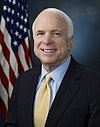 | ||
| Political activities |
| ||
| Media |
| ||
| Family | |||





| International | |
|---|---|
| National | |
| Academics | |
| People | |
| Other | |

- John McCain
- 1936 births
- 2018 deaths
- 20th-century American Episcopalians
- 20th-century American male writers
- 20th-century American non-fiction writers
- 20th-century American politicians
- 21st-century American male writers
- 21st-century American non-fiction writers
- 21st-century American politicians
- 21st-century Baptists
- American male non-fiction writers
- American memoirists
- American people of English descent
- American people of Scotch-Irish descent
- American politicians with disabilities
- American torture victims
- American Vietnam War pilots
- Aviators from the Panama Canal Zone
- Baptists from Arizona
- Burials at the United States Naval Academy Cemetery
- Candidates in the 2000 United States presidential election
- Candidates in the 2008 United States presidential election
- Deaths from brain cancer in Arizona
- Deaths from glioblastoma
- Episcopal High School (Alexandria, Virginia) alumni
- International Republican Institute
- Contestants on American game shows
- McCain family
- Members of the Sons of the American Revolution
- National Heroes of Georgia
- People from Colón, Panama
- Politicians from Phoenix, Arizona
- Protestants from Arizona
- Presidential Medal of Freedom recipients
- Recipients of the Air Medal
- Recipients of the Distinguished Flying Cross (United States)
- Recipients of the Legion of Merit
- Recipients of the Meritorious Service Medal (United States)
- Recipients of the Order of the Cross of Terra Mariana, 1st Class
- Recipients of the Silver Star
- Recipients of St. George's Order of Victory
- Republican Party members of the United States House of Representatives from Arizona
- Republican Party (United States) presidential nominees
- Republican Party United States senators from Arizona
- Shot-down aviators
- United States Naval Academy alumni
- United States Naval Aviators
- United States Navy captains
- United States Navy personnel of the Vietnam War
- Vietnam War prisoners of war
- Writers from Arizona
- Zonians